Wednesday, April 23, 2014

Raised in a Barn

Barn is from Old English bereærn literally "barley house," bere "barley"aern "house" (Old Norse barr "barley" is cognate with Latin far [genitive farris]) "coarse grain; meal," from PIE root *bhars- "bristle, point, projection".

    Bristley Barley Sheaf

Bairn is a child of any age. From Old English bearn "child, son, descendant," probably related to bear(v.) from Old English beran "to bear, bring, produce; endure, sustain, wear, from Proto-Germanic *beran-, from PIE *bher-(1) "give birth" and "carry a burden, bring." Maybe we call a child a "bairn" like as if we were to say the baby is the "born" instead of what we say "newborn," i.e., the new-bairn.

Bear (n.) the animal is from Old English bera, from Proto-Germanic *beron, literally "the brown one," from PIE*bher- (2) "bright, shining, brown".

    European Bown Bear

This root survives in English in the word burnish "to make smooth or glossy; polish".

Perhaps bear is "brown" with the sense of brown being a warm electric color like the different shades of amber, the bright shining stone, called elektron in ancient Greek.


    Amber, many shades of Bher(Bright) Brown, photo by Julie O. /chthonickore

And a bear is also "brown" being the brown color of broth and what is brewed like beer made from barley (bere / barr).  Brew is from Old English breowan "to brew," from PIE *bhreue- "to bubble, boil, effervesce (cognates: Sanskrit bhurnih "violent, passionate," Latin fevere "to boil, foam"). 

Many people have bhurnih (passionate) desire for their beer and like it fevere (foaming) on the head. 


  Brewed Barley Beer, Ranges in shades of Amber and Brown and is Bher(bright), by Barley Brothers

Bears may look both bristly (*bhars-, like barley) and grizzly gray, amber or brown and they bear young.

Bears are not barren, but things that are seared "dried up, withered, barren" may be sorrel "reddish-brown," like amber. And in no way are bears bare, from Old English bær "naked, uncovered, unclothed." However, what is barren, from Old French baraigne/baraing "sterile, barren" we might say is bare, like a wasteland. Barren places like the desert mainly deal in shades of amber and brown. Those dry places appear to be less fruitful than the wetter places. So there would be an association with brown and barrenness.


    Barren World, Deviantart, by TheHunterminater 

Barren places are also often warm places and may have a baked appearance. Bake is from root *bhe- "to warm".

Brood comes etymologically from idea of "that which is hatched by heat," from *bro- "to warm, heat," from PIE *bhre- "burn, heat, incubate, from root *bhreue- "boil, bubble, effervesce"(the same base root as brew
"O Jerusalem, Jerusalem, killing the prophets and stoning those who are sent to you! How often I would have gathered your children together as a hen gathers her brood under her wings, and you would not! Behold, your house is desolate [eremos, like barren]. For I tell you, you will not see me again, until you say, 'Blessed is he who comes in the name of the Lord." Mt 23:37-39
    The Little Red Hen, 2007 Publications Int., Ltd- "A dry spell kept the rain away from the little red hen's wheat for a week."

Many times words for baby animals are transferred by use to human children. For example, in English starting at the end of the 16th century kid meaning "the young of a goat" began to be used as a word for child. It is also interesting that in Hebrew one word for sheep, lamb, flock (goats and sheep, lamb) is son / tsone צאן. This is similar in sound to the English word "son." Perhaps the origin of tson is related in concept to the PIE root of son, i.e., *seue-(1) "to give birth"[the son is the one birthed]. Therefore the son of God would be the tsone "lamb" of God.

Lamb is from Protp-Germanic *lambaz, also the source of Old Norse, Old Friscan, Gothic lamb, Dutch lam, Middle High German lamp, German Lamm.
And I saw no temple in the city, for its temple is the Lord God the Almighty and the Lamb. And the city has no need for of sun or moon to shine upon it, for the glory of God is its light, and the lamp is the Lamb. Revelation 21:22-23
In Greek luchnos / lychnos λύχνος is lamp. Maybe that light of the Lamb in Revelation is like an electric (from Modern Latin electricus "resembling [electrum] amber") lamp. So it doesn't matter if sun or moon are shining . . .  much like today. In fact there is so much light at night now, because of electricity, that people call it light pollution. 

    Electric Light Pollution Gives a City an Amber Glow, Los Angeles Basin at Dawn from Mt. Wilson, Dec. 12, 2002

Child is from Old English cild (pronounced as is children) "fetus, infant, unborn baby, newly born," from Proto-Getmanic *kiltham "womb," (source of Gothic kilþei "womb," inkilþo "pregnant," Old English cildhama "womb," literally "child home." This original sense of "child" is retained in how we say a woman is "with child," meaning she is pregnant, when we don't normally specifically refer to babies in the womb as children. For example, we don't say, "When is the child due?" we say, "When is the baby due?"

Kind is "child" in German. A child is a "kind"(of the same sort) of the parent or kin to the parents. Kin is from Old English cynn "family; race; kind, sort, rank; nature; gender, sex." From Proto-Germanic *kunja- (source of Old High German chunni "kin; race, German Kind "child"), from PIE *gene- "to produce, give birth, beget"(as in genus/genera). One evidenced source of *gene- being Old English cennan "beget, create." The kind "child" is the one begat. This may remind us of Cain Qayin the son of Adam and Eve, and the Hebrew origin of his name, qaneh "get, acquire".

A human child (one begat) is called an embryo until about eight weeks gestation. Embryo is from Greek embruon / embryon "a young one," first used of animals, then humans. Literally meaning "growing in," from en "in"+ bruo/bryo "swell, be full." As little ones are want to do in their mother's wombs.

After the embryonic stage the child is called a fetus. Fetus is "the young while in the womb or shell," it is from Latin fetus, which according to the OE has the meaning "the bearing or hatching of young, a bringing forth, pregnancy, childbearing, offspring," but fetus also had extended meanings having to do with the fruit of plants and other growths of plants such as shoots or suckers. Fetus is said to be from the PIE root *dhe(i)- meaning "to suck." But this meaning of "suck" still has to do with things that bear, in that, the thing that is bearing offspring or fruit is the thing that was sucked from. What is sucked is energy and matter, being taken from one thing and given to another new thing. 

Clay Female with Cild, photo and sculpture by Julie O. /chthonickore

This
*dhe(i)- "to suck" is also the root of words like fecund (the thing sucked[of its energy] that "produces and yields"), female ("one who suckles," but also the "one who is sucked" of energy and matter during the gestation and pregnancy, not just after birth when the baby suckles milk), and felicity (the happiness that comes from benefiting from things that have such abundance of energy that they make fruitfulness and fertility possible). This example of felicity being related to the same root as fetus is similar in concept to the origin of udder "milk gland of a cow, goat, etc.," being the same root as the Latin uber "udder, breast," and  sharing the same root with 
exuberance "over abundant" (ex + uberare "be fruitful," related to uber "udder")


    Dolphin Fetus in Delphys

Dolphin is from Old French dauphin, Latin delphinus, from Greek delphis, related to delphys "womb".

Womb itself comes from Old English wamb "belly, bowels, heart, uterus", from Proto-Germanic *wambo "belly, paunch".

A dolphin is a womb animal. Therefore calling a dolphin after "womb" is maybe like naming mammals after mammary glands. Mammal is from Latin mammal, from mammalis "of the breast", and mamma "breast"(cognate with mamma "mother")


    Nursing Child, by women-health-info.com

Mammals are womb animals, but only the women contain a womb and are womb-men, right? i.e., the adams (men / humans) with a womb, and are the ones with the working mammas (breasts). However, both men / males and women / females are born from a womb and are suckled from the breast. In that way both are mammals. So, perhaps we might have been called delphins / dolphins after the delphy"womb," rather than mammals after mammary glands(and so some have been, e.g., the Dauphin de France).

The child of a mammal born from a womb suckles. In Latin felare is "to suck", and filia "daughter" and filius "son" is from *felios "a suckling". Whereas in English son has the connotation of the one "born"(*seue-) from the parent, rather than being a suckling. 

Furthermore, I would venture to say that daughter (dustr in Armenian) could be related to the origin as dust from PIE *dheu- (1) "dust, smoke, vapor" and dew *dheu- (2)"to flow." A daughter is the child who becomes a mater, Latin for "mother," and from that mater (mother) an adam (human) is given the matter of their body from the adamah (Hebrew for "ground, earth, dust") which makes us mortal or changing / flowing " *dheu-," or tau ("dew" in German). A tau (τ) which was derived from the phonecian taw (χ) is a cross; and "the cross of matter" is both bitter and beloved (like the name Mary. She who is the mater [mother] of God). Being born into flesh (nailed to the tree / tau / cross / zodiac) brings the knowledge of the beautiful (good) and adverse (evil).  


    Cross of Matter, the Cardinal Directions

For it was the daughter, Eve, who brought about the fall (change) which is called "happy", i.e.,  Felix [happy in a "fruitful" way] culpa. So we could say the daughter is the *dheu- ter, that is "the bringer of flow / change.

Nurse is from Latin nutricius "that suckles, nourishes," from nutria / nutricis "wet-nurse",  nutrire "to feed, nurse, suckle, foster, support, preserve". 

Nut / Nuit, the ancient Egyptian sky goddess (originally of the nighttime or nuit-time sky) was the primordial "nurse" or nurturer of ancient Egypt. She was a mamma goddess of death and rebirth who swallowed the heavenly bodies each night and gave birth to them, or "raised" them, every morning from her womb, the eastern horiz(e)on. Sometimes she was portrayed as a nude woman covered with stars arching over the sky (night sky) and was said to touch the cardinal points of the earth with her fingers and toes (the world tree). She was also portrayed as the sycamore tree, nht or nehet in ancient Egyptian. She was the Nut tree.


    Nut Offering Food and Drink with Lotus/Lilies to the Deceased, Tomb of Sennedjem at Luxor (ancient Thebes), 19th Dynasty
I am Nut, I have come to thee bringing thee gifts. Thou sittest under me and coolest thyself under me and coolest thyself under my branches. I allow thee to imbibe of my milk and to live and to have nourishment of my two breasts; for joy and health are in them…Thy mother provides thee with life. She sets thee within her womb wherein she conceives. -from the tomb of Kenamun

The Greek city of Delphi was originally called Pytho Πυθώ, by certain accounts, after the great serpent, Python, son of Gaia, who protected the navel of the earth and was slain by ApolloPythia was the title of the Delphic oracle.


    Priestess of Delphi, John Collier, 1891

Pythoness is a "woman with power of soothsaying" from Old French phitonise, from Latin pythonissa. In the Vulgate the Witch of Endor, whom Saul consults to summon the ghost of Samuel is described as," mulierem habentem pythonem1 Samuel 28:7.

Delphi was were the omphelos, "navel" in Greek, of Gaia (Mother Earth) was located, thus the center "hub" of the world and delphys "womb". 


  Stone Omphelos in Delphi Archaeologic Museum

We might say that navels are ventral meaning "of or pertaining to the belly, stomach, abdomen," from Latin venter / ventris "belly, paunch; stomach, appetite; womb, unborn child". The belly is a pretty squishy watery part of the body, you can hear liquids sloshing around in the stomach after drinking, and of course the child in the womb is surrounded by "water", i.e. amniotic fluid. 

In Swedish vinter is "winter" said to be maybe from *wed- "water, wet." The womb is a wet place and it is also a place of winter for the child, not cold winter, but dark. The womb is the place of darkness right before the springing forth of the new life. The womb is a kind of den of hibernation, from Latin hibernus "of winter," and a perfect incubator for a tiny developing man-cub. However, once they are raised sufficiently and start acting like kids do, we all know were they belong… in the barn.


Wednesday, April 2, 2014

Because I'm Happy!

    Leonardo da Vinci, Mona Lisa (La Jaconde, La Gioconda)1503-as late as 1516

Why is she smiling like that? Mysterious, like, "I ain't happy, I'm feeling glad, I got sunshine in a bag. . . ," almost… jocund. But then again, that's her name after marrying Francesco del Giocando, i.e., Lisa (Gherardini) del Giocando. That's sort of funny, kind of like a joke, from Latin iocus. And jocund from Late Latin iocundus, variant of iucundus "pleasant, delightful, helpful." We know that humor is pleasant and helpful. In fact it is good for health. But something tells me its more than that. Something is funny, but you're not in on it. Do you want to be in on it? Come here, I'll whisper in your ear . . .

Here is the ancient Egyptian god of the annual inundation of the Nile. He is a blue god. But he wasn't "blue" sad, he was Hapi.


Hapi / Hap / Hep was the bringer of good things, his annual appearance was indeed fortunate. This annual flooding was said to be the Arrival of Hapi, because the flooding deposited silt, and was the cause of fertility of the Nile delta region. His blue skin was representative of water. Water is necessary for life, not only for drinking, but also for the survival of game and fish, and growing of crops. Hapi was known as, Lord of the fishes and birds of the marshes.

The ancient Egyptian calendar during the Middle Kingdom was based on the heliacal rising of Sirius (Sopdet in ancient Egyptian) which heralded the Arrival of Hapi and the agricultural new year. At this time, July, Sirius is a morning star. At our new year, the beginning of January, is when Sirius rises as an evening star. From May to its rising in July, a period of 70 days, Sirius is not visible (because it is out during the day/conjunct the sun).

Happy first had the meaning of "lucky, favored by fortune, prosperous," in the sense of "turning out well" from hap "chance, a person's luck, fortune, fate." So maybe in this way someone might not appear to be very happy or lucky, like Andy, in the Shawshank Redemption when he is crawling through the sewage pipe, puking his guts out, after being in prison for 19 years. He certainly wasn't happy when he was in prison being raped and abused, but he was planing something from the very start. . . which sometimes made him glad. And also the little victories, like being out in the sun and getting to see his fellow inmates drink a beer.


    Andy Dufresne(Tim Robbins), Shawshank Redemption, 1994

Happy comes from a sense of being blessed (beatitude) or lucky, which is said to be "probably from early Middle Dutch luc, shortening of gheluc "happiness, good fortune" a word of unknown origin[OE]." Luc is similar in sound and has certain correspondence in concept, to PIE root *leuk- "light, brightness" (such as a happy person may be bright eyed, and a fortunate person has the light shining upon them), so perhaps there is a connection with the word light which is from Proto-Germanic *leukhtam (from PIE root *leuk-). The light shining upon a person can be said to be good luck, or God's light, perhaps God luc (good fortune), or *gheu(e) "to call, invoke" luc "happiness," 
"You will also decide and decree a thing, and it will be established for you; And the light [of God's favor] will shine upon your ways. Job 22:28 [ABT]

But is being blessed and lucky always make you happy? Does it always feel light? or like the light? 

People often feel blessed when things are going their way. They may feel "happy"as in, content, from Latin contentus "contained, satisfied." Or they may be "happy" in the sense of joy, felicity, merriment and mirth, when celebrating good things and blessings. It can be downright jolly "festive, merry," from Old French jolif "festive, merry, amorous, pretty," (of uncertain origin). Yule / Jol / Jul, is 
the turning of the "wheel" hjól in Old Norsefrom the dark part of the year to the returning light. It is the completion (or contentus, satisfaction) of the year. Yule is from Old English geol (cognate with Anglo-Saxon giuli and Old Norse jól ).  We would probably say that Yuletide is the jolliest time of the year. Jolly are the celebrations and traditions relating to Odin called Jólnir "the Yule One," Santa Claus, Dionysus and the winter solstice. However, when you are making merry you are not making happy, lets face it. You often pay the price in the morning. Even if you don't go so far as to get pissed. . . or drink and piss at the same time, like baby Bacchus here who is drinking out of a literal fiasco, maybe you ate too much rich food, or danced a lot and have sore feet, etc. When you are feeling happy in this world you are set for a fall. 

    Guido Reni, Dinking Bacchus(Dionysus), c 1623

Christmas, the birth of Emanuel, is merry, but Jesus still had to suffer and die, so maybe it is a little bit myrrh-y in this manner. Easter is happy because the suffering is past. Its morning! The day of resurrection. But, Christ, what suffering he had to get to the glory of Easter! Christmas was "when half spent was the night." So it was blessed/happy in that way, the event was occurring which would bring about the morning (and it was a morning in its own way), but it was in its very early infant stage. The light part of the day does not bring the morning. It is only when it is night that --> then the morning comes.

This is Mary Magdalene. She doesn't look very happy does she? There in the dark resting her head on a skull, Golgotha. But we might say she is indeed happy/blessed.
Blessed are those who mourn for they shall be comforted (parakaleo). Matthew 5:4 
Happy are those who are morn-ing?

   Giacomo Galli, The Penitent Mary Magdalene, 1620-1640 Baroque

Might the one who is mourning be waiting with faith for, or placing their hope in the dawn? So in that way a mourner is morn-ing, or waiting for the morn. Why should this make one happy? This merry/myrrhy/happy is the light in the dark, but it doesn't necessarily feel merry or happy. It's more like a secret, secret knowledge… sunshine in a bag, redemption is at hand. When one is happy already, it is already day, then you have your reward. 

There is no longer movement to darkness once you have your portion and your piece (peace), i.e., heaven. So choose wisely, make sure your portion is sufficient and is your heaven before settling for it. If you haven't chosen your portion yet, then expect to be moving through night to reach it. That's why those who mourn are blessed. As surely as the sun rises each day, when you are in darkness the dawn will come and bring the light of the new day.

This Archaic Period Kore has half her face smashed off why is she happy? She is touching her heart, that is where the truth lies. In this world there is suffering. We are abused and broken. We grow old and die. But that is not the end of our story.


    Lady of Auxerre, Archaic Kore, c 630 BC, Louvre

Why are we here? What were we made for? Are we really nothing and dust, fit and deserving of decay? If so, what of the flame inside of us which gives us life that was made in the darkness when it was hidden and sprang forth like the dawn? "Yehi owr"
And God said, "Let there be light"; and there was light. God saw that the light was good; and God separated the light from the darknes. God called the light day, and the darkness He called night. And there was evening and there was morning, one dayGenesis 1:3-5
Just to be created (means you are a creature) by the very nature of that fact means to be less than God, to be less is a lack of perfection and we might say, sin. And of those created, creatures, i.e., those in matter are most "dirty," being made from the adamah "ground, earth". However, this matter far from being just dirt is part of our being and is elevated by spirit. God did not make us to be in sin and darkness, however, it was part of the process. Until the dawn you are not fully created (in the prayer to the Holy Spirit it states,"and they shall be created"). This process is day, night, morning: one cycle / day (yom in Hebrew). It is the miracle of life. Adam (clay of the earth, humus+ Eve / Havvah (mother of the living, anima) = human animal. Created in the day, fell into darkness, and were redeemed in the morning. That is the wonder of creation. And the wonder of God incarnate.

 A Human Child Created in Darkness, Yet to See the Light of his First Day, photo "Ronan" from Julie O. /chthonickore (2012)

Miracle is from Latin mirari "to wonder at, marvel, be astonished," figuratively "to regard, esteem," from mirus "wonderful, astonishing, amazing".
The miracle which is this wild ride of life is a revelation, a looking in the mirror of truth. And although what is seen when it is bent back / reflected is astounding, a marvel, and sometimes shocking, we admire it. This appearance can also be the cause of joy, or bring a smile to our faces. Mirus itself comes from *smeiros, from PIE *smei- "to smile, laugh". Why? What is good about a fall? And what is humorous about seeing a distorted or imperfect reflection? 

Well, actually a lot. Think of bloopers, funhouse mirrors, or strange smartphone / computer photo filters


Funny Pictutre, Julie O./chthonickore

Laughter is born from the night. The twisted image is funny, not evil. It would only be evil to get stuck like that, to take the picture and have to look like that forever. That would be bad. However playing around is fun. Seeing someone slip and fall can be really funny also, if they don't get hurt or twist an ankle. When someone falls and is forced to climb back to the top they gain a sense of accomplishment and self-esteem. When an impossible task is achieved the labor is forgotten and replaced with joy. The amount of joy and laughter is proportional to the knowledge of the experience of pain and sorrow. The night causes us to appreciate the day.
"Therefore I tell you, her sins which are many, are forgiven, for she loved much; but he who is forgiven little loves little." Luke 7:47

    Spiral staircase (Lul), Vatican Museum, Rome, design Guiseppe Momo, 1932

This looping staircase could be representative of being in time, the spiral of time; minutes to hours, hours to days, days to months, months to years, years to eons. A spiral can go on and on in endless loops. Does the staircase bring you down or does it take you up? Actually, both equally, right? What if you didn't know which direction was up? With gravity that's not a problem. Being here on earth incarnated in flesh our mortal bodies give us sufficient weight. We feel the pull downwards toward the grave and eternal darkness. We long to be lighter and more free.

In Aramaic lela, biblical Hebrew layil / lel / leyelah ל׳ל is "night," from the same root as lul לול "winding stairs." These are things that "turn, twist," "fold back," or lulay / lulaah "loop." Night has this connotation of turning (from the light or day) and looping, twisting which can be negative. Things that twist are twisted, and can also be ensnaring, or encircling, and coiled like Leviathan, from livyah "wreath, garland." Laviathan is the mighty and unstoppable serpent of the abyss.

Apep / Apophis the wreathing, twisted, garland serpent- Egyptian Middle Kingdom, World Encircler, Enemy of Ra, Earth-shaker, Evil Lizard, Serpent of Rebirth, The Great Rebel, Eater-up of Souls
Behold, the hope of man is disappointed; he is laid low even at the sight of him [Leviathan]. No one is so fierce that he dares to stir him up. Who then is he that can stand before me [the Creator]? Who has given to me, that I should repay him? Whatever is under the whole heaven is mine. Job 41:9-11 
When God was creating the day, it was day, then things took a turn, looped, the day went to night, but then turned back to morning. That whole process was one complete day. And this did not happen just once but 7 times, the number of perfection and completeness. The night is part of the day, because of this bending back / looping. And it was good.
So God created the great sea monsters and every living creature that moves, with which the waters swarm, according to their kinds, and every winged bird according to its kind, And God saw that it was good. Genesis 1:21
If the night was bad then how could it be part of the day? Or why would it be?
How would anything have endured if you had not willed it? Or how would anything not called forth by you have been preserved? Wisdom of Solomon 11:25
In the context of the day, i.e., the loop, the night is not evil, it allows for the experience of life. Ánka in Lithuanian is "loop, ring." And the ancient Egyptian ankh is a tau (Τ τ) with a loop on top, and it means "life, living" (and also "mirror" an image bent back / reflected).


However, in another sense the turning / looping (ankh), "life" is also the cause of death. That is, being fixed on the cross (stauros in Greek) of matter, or being born into matter through a mater, "mother" (in Latin), is what then causes the experience of change and death and the experience of night and darkness as evil.  Like all descendants of the primordial woman Eve, the mother of the living, who's name was given as Chavvah, meaning "life." A similar symbol to the loop on a cross, is a circle on a cross. It is the symbol used to represent "woman" and the planet Venus, the planet named after the goddess of love and desire. This gives new meaning to the idea of embracing one's cross.
Then he said to them all: "Whoever wants to be my disciple must deny themselves and take up their cross daily and follow me.  Luke 9:23 [NIV]
    Female / Woman / Ankh / Venus

This loop or cycle is life, but it is also true that life is the leading cause of death. There is always the danger of creation falling into night and staying there, when spirit incarnates in matter. If the loop is not completed, when day turns to night then there is eternal darkness, but if day turns to night, then back to morning there is one complete cycle or day (yom in Hebrew). 

When the light came into being it was then that darkness became darkness or evil in opposition to the light. This might make sense of why this sound / word "ankh", which is the name of a symbol in the shape of a thing curved or bent back, and has the meaning life in ancient Egypt, came to mean death in other cultures. The curving / bending back is not only the pattern of life, but also the reason for the experience of death. In Welsh angau (from angheu --> *ankow --> *ankus) and Breton (Celtic) ankou is "death," and is personified as the figure Ankou, a cloaked skeletal figure with scythe. Proto Indo-European root *ang / *ank is said to have the meaning "to bend," and things bent can be, well . . .  bent or crooked,  ankylos ("bent, crooked") in Greek, or evil. 

Is night evil? When the light was created it was called good, however, the birth of the light automatically set up its source for vilification. The light is the cause of the darkness being viewed as evil. However, the day or the light, embraced the darkness, and, in Wisdom, redeemed it with this cycle or turning / looping, day by day. The mother, the infinite sea of potential, rather than being condemned for not being the light, is redeemed by the light. Just as the Christ, was born from a woman and is the savior of all creation. In the beginning the light emerged from the dark waters of infinite potential. 
In the beginning God created the heavens and the earth. The earth was without form and void, and darkness was over the face of the deep. And the Spirit of God was hovering over the face of the waters. And God said, "Let there be light," and there was light. Genesis 1:1-3
And then the light was separated from the darkness, but the darkness was not called evil. God's Wisdom is revealed by this reflecting or turning from the dark to light. 
For she is a reflection of eternal light, a spotless mirror of the working of God, and an image of his goodness. Though she is but one, she can do all things, and while remaining in herself, she renews all things … For she is more beautiful than the sun, and excels every constellation of the stars. Compared with the light she is found to be superior, for it is succeeded by the night, but against wisdom evil does not prevail. Wisdom of Solomon 7:26-30
When the light loops it turns to night, so it is a fall, but when the dark loops it turns to day. The fall of the night brings the glory of morning. And because of this happy little trick, the night is not evil.

The fall was not an eternal fall or night, rather it was a loop into matter. The spiritual falls into to the flesh, and is raised again to the spiritual. The mother provides the flesh of man (adam) as matter-earth (adamah), and the mother grows the child in her womb, but the mother is the mother of the living (Chavvah / Eve), those with the spirit / breath of life (ankh). It was this living spirit that in innocence ate the fruit of the tree of knowledge, knowing that only good comes from God, so all was good, and the fruit was good, so they ate it. And a good did come from it, a greater good than would have been, . . . however, first it brought the night, then the new day.

    Michelangelo, Downfall of Adam and Eve and their Expulsion from the Garden of Eden, Sistine Chapel, 1508-1512

The words for night, naked and dead actually are more closely related in English than they appear to beNight is from Old English niht "dark part of the day; night; darkness," from Proto-Germanic *nahts- "night, darkness"(source also of Dutch nachtGerman Nacht, Old Norse natt), from PIE *nekwt- "night"(shared by Greek nyx / nux νύξ and Latin noxnoctis "night.") 

So, night is from *nekwt- which is like the word "naked." Naked is from Old English nacod "nude, bare, empty," also "not fully clothed," from a root shared by Old High German nackot, German nackt, which is a lot like nacht "night." Night is "dark" *neg-, in the sense of the part of the day which is a turning away from the light, and figuratively this turning from the light can mean "going toward wickedness or evil." Nakedness is generally given a negative connotation and thought to be naughty which sounds like noctis. And the naughty night and darkness is said to be evil like death.

Nekus / nekys νέκυς in Ancient Greek is "dead body, corpse, what lacks life." The dead body is nekus, or might we say naked? Nekros (from nekys) is "dead, lifeless, dead body"(as in necropolis, necromancy), from PIE *nek- "death, natural death". *Nek- is that which has gone to *neg- "darkness, night" and… become naked / neked (deathed)? 

Doves are innocent and "naked" like babies, but serpents are wise "naked" as in, smooth and shrewd (Matthew 10:16). In Latin nex, genitive necis is "violent death, murder," nocere is "to harm, hurt." The serpent (s-nek) in the garden was called crafty / naked (arom) and was said to be a murderer (necis) who intended to harm (nocere). 

The snake in the garden was arum, very crafty and smooth. Adam and Eve were arom, naked smooth. They were naked and not ashamed in paradise, like children spiritually. They were innocent (from not + nocere). They had not yet experienced the fall or decent into the spiral (lul) of time which they would have to climb in oder to reach the day again. Looping can lull us to sleep like a lullaby in the endless circles of time.
"Awake, O sleeper, and rise from the dead, and Christ shall give you light." Ephesians 5:14

ḫ', "sunrise", "rejoice" Hieroglyph

We have hope in the perfect day, i.e, eternal recreation (recreation because the completing work of creation is finished and what is left is to enjoy it). 
This is the day that the Lord has made; let us rejoice and be glad in it. Psalms 118:24
Adam and Eve were naked children, they had not experienced the night or death. It was day, and was good like paradise, but day does not consist only of day. Day always goes to night. If going to the night is evil or fearful one is still a child and not an adult. If Adam and Eve were already spiritual adults they would not have feared darkness. They needed a new day in which they would be perfected and become spiritual adults. But how do you leave one day to reach the new day without first going into night? Becoming an adult involves experiencing the pain involved with gaining the knowledge of adversity, and experiencing the "death" of the child-you. Sad . . . but joyful too.
O felix culpa quae talem et tantum meruit habere redemptorem. 
Oh happy / lucky / blessed fault / fall that merited such and so great a redeemer. - Exultet of the Easter Vigil
It is interesting, funny even, that the bringer of the life of the new day is also the bringer of death / change, and that death is actually a victory. Like how Jesus stuck it to the devil by dying. The devil thought he had him. How can suffering and death and being nailed to a cross be good?
"Cursed be everyone who hangs on a tree." Galatians 3:13
    Christ on the Cross with Mary Magdalene[Good Friday], Luca Signorelli, c. 1490 

But then, Christ razed hell, rose from the dead, and opened the gates of heaven to everyone. True freedom made possible because of the fall. Lol. You are so dumb, Satan, you are really dumb!

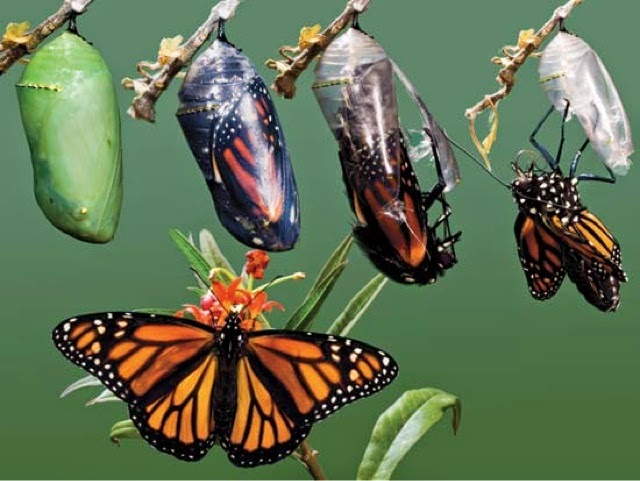
The bringer of new life is also the bringer of death. . . that is, death to the old life. Like a child who becomes an adult, we might say there is a violent end (necis) to the child, it is transformed into the mature body and completely changed. Who gets asked if they want to go through puberty and become an adult? Is it a good thing for the child to die and the adult to be born? It is debatable. Yet it is happening in any case. It happens by force of nature. It is the world we live in, the world of sin and death.

    Metamorphosis of the Monarch Butterfly(partial), Anthony Mercieca/Photo Reserchers, Inc.

If one is not yet a Christ, he / she is not truly an adult. If you are in sin and death, then you are in the night, not yet the morning. Physically Adam and Eve may have been adults in the garden of Eden, but they were children spiritually. Physically we may be adults now, but we are not innocent children spiritually. We may be children, but children with sin, not innocent. 
For although by this time you ought to be teachers, you need some one to teach you again the first principles of God's word. You need milk, not solid food; for everyone who lives on milk is unskilled in the word of righteousness, for he is a child. But solid food is for the mature, for those who have their faculties trained by practice to distinguish good from evil. Hebrews 5:12-14
And neither are we spiritually adults until we know good from evil and are able to practice love rather than jealousy and strife.
But I, brethren, could not address you as spiritual men, but as men of the flesh, as infants in Christ. I fed you with milk, not solid food; for you were not ready for it; and even yet you are not ready, for you are still of the flesh. For while there is jealousy and strife among you, are you not of the flesh and behaving like ordinary men? For when one says, "I belong to Paul," and another, "I belong to Apollos," are you not merely men? 1 Corinthians 3:1-4
We have fallen very far. We have fallen so far that we don't trust our hearts. We have been lulled to sleep and don't know which way is up or down, we confuse black with white, day with night, we say we are clothed when we are naked, we say we are salty when we are tasteless, and the light of the world when we are darkness. How can one climb out of a pit of that magnitude? It is so deep we need a ladder or staicase out of it. How is a staircase of such magnitude made so as not to be too steep, difficult, or treacherous? How can it be done?

It is curved in a spiral. It's a lul (winding staircase) in the creation of the day. It loops. A crazy loopy solution to a problem. It's kind of miraculous, and can be funny. 

    The Well of Initiation, Inverted Tower, Quinta da Regaleria, Portugal, c. 1904-1910


What will happen to us? Doesn't everyone want to know this? Here is a secret... you already know the story. The answer is one Word; Day, night, day - one day… and it was good.


Tuesday, March 25, 2014

*The Sin of Sodom and Gomorrah - Genesis 19

When you look at what people have to say about the sin of Sodom and Gomorrah they usually say it was homosexuality. God destroyed the cities because they were having samesex sex in those cities and it was obviously very abhorrent to God. According to the story, the men of the town did want to have sex with the male angel visitors. So because these men wanted to have sex with the male angel visitors the sin of the city was homosexuality. Others say, no, it is the fact that the men of the town were being inhospitable that is the sin. Both of these explanations seem to fall short of the obvious, i.e., rape. To quote a popular internet news clip,
Hide your kids, hide your wife . . . and hide your husband . . . 'cuz they rapin' everyone out here . . .  -A.Dodson
The people of Sodom and Gomorrah were morally depraved rapists. They were bored with sex and the people available to have sex with. They had already had sex inside, outside, upside down and backwards. When the new people arrived they were turned on, something was happening, it was a new fix, something to quell the unbearable torture of their boring pointless existences, even if just for a moment. The visitors were angels, they were probably pretty compelling. I'm sure they were very beautiful.

    Archangel Michael - Legion, 2010

It is true that the men of the town preferred the angels over Lot's daughters, yes. However, we don't know what Lot's daughters looked like, and maybe there is a reason why they were able to remain virgins in such a town. Who knows? In any case, they were probably not as good looking or exciting as the angels, which for someone driven by uncontrolled depraved lust, would be a compelling consideration and might help tip the scales in favor of the angels. Let's see, Lot's plain daughters…or the hot mysterious guests, hmm.

    Archangel Gabriel Legion, 2010

We know that the fiancés of Lot's daughters didn't come with them when Lot asked them to. Maybe they were happy to get out of the arrangement, besides not taking Lot seriously? Then the daughters ended up raping their own dad in order to have children. So, it is fair to say that the men (and women) of the town were perverse. They did not want to have sex for spiritual connection, but rather plain lust (or selfish aspiration). They were not asking to have sex with the visitors. They were demanding for them to be handed over for their own personal sexual gratification at the visitors' expense. And Lot wasn't all that great himself (offering to hand over his own daughters in place of the angel guests), but at least he hadn't sought to rape the angels himself and had instead tried to protect them, so they were going to save him for that good deed. However, Lot didn't even realize that the visitors didn't need his protection. He wasn't too bright, and did't exhibit a lot of faith or obedience on more than one occasion. The angels literally had to drag him out of the city by the hand. Genesis 19

I'm sure the angels didn't have wings when they showed up in town, but it is just a way of depicting their otherworldly awesomeness. Same thing with the halos in art which are meant to depict their bright auras. An angel is a shining one. Halos is a Greek word meaning "the disk of the sun or moon" which is shiny. Hals 
[hálas Koine] is a Greek word meaning "salt; sea" 

    Halos and Hals, by Julie O. /chthonickore

Sol is "sun" and sal is "salt" in Latin. There is a connection between that special something-ness of salt and the bright majesty of the sun. Halal is "shine" in Hebrew. Shine is zing, and salt is zing. Melach is "salt" in Hebrew and "angel" is malak. The malakim (angels) are melach (salty) like the majestic sea (hals), and salty like the sun (helios) and the moon (selene) which exhibit halos from their shinning radiance. It is this "saltiness" which makes the angels desirable. 

    Pink Himalayan Rock Salt, photo by Julie O. /chthonickore