. . . got those magic hands.

Khnum [ẖnmw] / Khnemu / Chnum / Chnoumis [Χνούβις] is an ancient Egyptian god of the waters, and creator / fertility god associated with the inundation of and source of the Nile. His name comes from the root word ẖnm "be united, associated with, be provided, endowed with," or "builder."
Not only were the waters of the Nile important for irrigation and transportation, but its annual flooding brought the necessary fertile silt and clay to the surrounding land. Water is fundamental for life. Khnum was said to fashion the bodies of humans on his potter's wheel and place them in the womb of their mothers along with their ka ("spirit", or a person's life force). He was associated with overseeing pregnancy and the initiation of labor as well.
Although we may sometimes forget, we all come from water. Water is our first home before we ever breathe air into our lungs. We gestate in the waters of the abdomen for nine months and then are born when the waters "break"/ issue forth.

Khnum is actually one of the more ancient of the Egyptian gods dating back to the 1st dynasty (2925-2775 BC). He remained popularly worshiped until the early centuries CE, however his name and physical appearance point toward his more ancient origins. Khnum was usually depicted as a ram or a man with a ram's head, but specifically with the twisting horns of the Ovis longipes palaeo-aegyptiacus, a type of domesticated barbary sheep found in ancient southern Egypt which became extinct sometime later during the New Kingdom (c.1567-1085 BC). His name in hieroglyphics also points to his early role as a water god. In hieroglyphics "Khnum" is written with a "water jug with handle" pictogram [as shown below] representing the phonogram ḫnm (khnum).

As a primeval god, this water jug is a symbol of greater importance than it may first appear. Remember the heavens themselves were described and imagined as water/s and the gods were shown traveling these "waters" in barques. The Milky Way was sometimes described as the "Nile in the sky." So the dramas that played out in the sky with the sun and stars were reflective and analogous of happenings below on earth. Just as the importance of the fertile fresh waters of the Nile were known to the Egyptians to be essential for abundance and life, so too, the gift of water from heaven was understood as it pertained to the spiritual life and provided life and health to the body.

In this sense we can connect Khnum with the symbolism of Aquarius (Gk. Hydrokhoos) the Water Bearer. Even if only based off of the fact that the depictions of Aquarius have ẖnm, i.e., the water jug, and thus the name of the god Khnum implicit. Khnum is quite literally the Water Bearer.

The wavy lines, as well, that denote the symbol for Aquarius [seen above] are themselves components of the determinative / logogram for "water; wave; to drink; to wash" in ancient Egyptian hieroglyphic writing, which is made with three wavy lines stacked together.
[also of note, Khnum's horns visually make this wavy water line symbol as well which represents the letter or phoneme 'n' in hieroglyphics]

Khnum represented the powers of these potent regenerative waters of life supplied to the world in the form of this vessel or pot.
Potent is from Latin potentem (nominative potens) "powerful," present participle of *potere "be powerful, able, capable." Khnum was most definitely then a Potere (powerful) Potter and pater ("father" in Latin) of the gods and humans. The ultimate PIE root of "potent" is said to be *poti- "powerful; lord".

These potent waters are most potable as well. Potable is not immediately and obviously connected to this concept of "potent" itself. It comes from a word meaning "to drink". Potable is from Old French potable (14c.), and directly from Late Latin potabillis "drinkable," from Latin potare "to drink" (from PIE root *po(i)- "to drink").
We see a noun form of the word potare "to drink" used here in the Vulgate,
The etymology of the word "pot" is said to be of uncertain origin, however.

Khnum fashions Ihy, Temple of Hathor, Dendera [detail from Inner Shrine]
Khnum [ẖnmw] / Khnemu / Chnum / Chnoumis [Χνούβις] is an ancient Egyptian god of the waters, and creator / fertility god associated with the inundation of and source of the Nile. His name comes from the root word ẖnm "be united, associated with, be provided, endowed with," or "builder."
Not only were the waters of the Nile important for irrigation and transportation, but its annual flooding brought the necessary fertile silt and clay to the surrounding land. Water is fundamental for life. Khnum was said to fashion the bodies of humans on his potter's wheel and place them in the womb of their mothers along with their ka ("spirit", or a person's life force). He was associated with overseeing pregnancy and the initiation of labor as well.
Although we may sometimes forget, we all come from water. Water is our first home before we ever breathe air into our lungs. We gestate in the waters of the abdomen for nine months and then are born when the waters "break"/ issue forth.

Khnum, from a tomb of a prince, Valley of the Queens, Luxor, Egypt, c12th century BC
Khnum is actually one of the more ancient of the Egyptian gods dating back to the 1st dynasty (2925-2775 BC). He remained popularly worshiped until the early centuries CE, however his name and physical appearance point toward his more ancient origins. Khnum was usually depicted as a ram or a man with a ram's head, but specifically with the twisting horns of the Ovis longipes palaeo-aegyptiacus, a type of domesticated barbary sheep found in ancient southern Egypt which became extinct sometime later during the New Kingdom (c.1567-1085 BC). His name in hieroglyphics also points to his early role as a water god. In hieroglyphics "Khnum" is written with a "water jug with handle" pictogram [as shown below] representing the phonogram ḫnm (khnum).

Khnum / Khnemu Hieroglyph
As a primeval god, this water jug is a symbol of greater importance than it may first appear. Remember the heavens themselves were described and imagined as water/s and the gods were shown traveling these "waters" in barques. The Milky Way was sometimes described as the "Nile in the sky." So the dramas that played out in the sky with the sun and stars were reflective and analogous of happenings below on earth. Just as the importance of the fertile fresh waters of the Nile were known to the Egyptians to be essential for abundance and life, so too, the gift of water from heaven was understood as it pertained to the spiritual life and provided life and health to the body.

Khnum-Ra traveling on the Solar Bark, from House of Eternity Seti I, KV17, West Uaset, diospolis Megale-Thebes

Water flowing from knum - image tarot.com
[also of note, Khnum's horns visually make this wavy water line symbol as well which represents the letter or phoneme 'n' in hieroglyphics]

"water; wave; to drink; to wash" - mw
Not all water / drink is equal, however. Water can be stagnant or fresh. The best water is that which is the cause of health, fertility, rejuvenation, and life. This water of life or living water is a gift.Babylonian astronomers identified the constellation of Aquarius as representing the god Ea, or "The Great One," which was often pictured with an overflowing vessel. In ancient Egypt, the water bearer's jar [*Khnum] was said to cause the spring overflow of the Nile when it was dipped into the river. space.com, Aquarius
Khnum represented the powers of these potent regenerative waters of life supplied to the world in the form of this vessel or pot.
Potent is from Latin potentem (nominative potens) "powerful," present participle of *potere "be powerful, able, capable." Khnum was most definitely then a Potere (powerful) Potter and pater ("father" in Latin) of the gods and humans. The ultimate PIE root of "potent" is said to be *poti- "powerful; lord".

These potent waters are most potable as well. Potable is not immediately and obviously connected to this concept of "potent" itself. It comes from a word meaning "to drink". Potable is from Old French potable (14c.), and directly from Late Latin potabillis "drinkable," from Latin potare "to drink" (from PIE root *po(i)- "to drink").
We see a noun form of the word potare "to drink" used here in the Vulgate,
caro enim mea vere est cibus et sanguis meus vere est potusIt's not crazy to think that these concepts are somehow related, however, namely the symbol of the potent potter, i.e., a pot (of sorts), and what is in the pot, i.e., drink (potus); potent, pot, potable. Khnum is a Poti (Powerful Lord) of the powerful / potent potus (drink).
[for my flesh is true food and my blood is true drink.] John 6:56
The etymology of the word "pot" is said to be of uncertain origin, however.
Nevertheless the concept of pot (a thing which holds liquid / drink) and drink (potare / potus) in this case are easily related in their association with this god (Khnum). The fact that the Divine Potter is intimately connected to both a vessel (pot) and water (and remember the hieroglyph for water [three wavy lines] also can have the meaning "to drink") lead to the consideration that the word "pot" and certain words for drink might ultimately be connected to the notion of things related to this powerful / potent god.
And there is, in fact, an early ancient Egyptian god who has connection to this particular word forming sound "pot", and he is also related in concept to Khnum. Ptah / Peteh / pth (pronounced Pee-tah) is the primordial mound / land, therefore rock (Pee-ter), also patriarch and pater ("father"), which rose out of Nun (primordial waters), or we might say rose out of none / nothing; the abyss.

Originally Ptah, or Ptah-Nun is thought of as the Divine Potter like Khnum. And his potter's wheel was the wheel of the revolving heavens, or sky waters. Ptah too was Poti (powerful; lord).
There was much mingling of the concepts of the ancient Egyptian gods over the millennia since they are really representative of concepts, and powers of nature personified. The transliterated word which we translate as "god" in ancient Egyptian is nTr / neter / netjer and plural nTrw / neteru / netjeru. This word pertains to divinities, spirits, and cosmic concepts.
And there is, in fact, an early ancient Egyptian god who has connection to this particular word forming sound "pot", and he is also related in concept to Khnum. Ptah / Peteh / pth (pronounced Pee-tah) is the primordial mound / land, therefore rock (Pee-ter), also patriarch and pater ("father"), which rose out of Nun (primordial waters), or we might say rose out of none / nothing; the abyss.

Ptah, from Tomb of Tutankhamun, Gilded wood, faience and glass., 1321-1343 BC, 18th Dynasty, Valley of the Kings
Originally Ptah, or Ptah-Nun is thought of as the Divine Potter like Khnum. And his potter's wheel was the wheel of the revolving heavens, or sky waters. Ptah too was Poti (powerful; lord).
There was much mingling of the concepts of the ancient Egyptian gods over the millennia since they are really representative of concepts, and powers of nature personified. The transliterated word which we translate as "god" in ancient Egyptian is nTr / neter / netjer and plural nTrw / neteru / netjeru. This word pertains to divinities, spirits, and cosmic concepts.

Neteru / Netjeru / nTru in hieroglyphic form written by the three flags, Coffin of Paduamen[detail], Egyptian Museum Cairo, 21st Dynasty (c.1069-945 BC)
Over thousands of years of time, and introduction of different peoples and cultures the stories / mythologies shifted and mingled, and "different" neteru would become prominent. Sometime around 2686 BCE Upper Egypt (which is actually geographically south) invaded Lower Egypt to the North and unified the two kingdoms. Khnum represented Upper Egypt whereas Ptah-Tatenen represented Lower Egypt. Both were considered to be self-created creators.
And we can look at other so called water gods and see connection of concepts with Khnum and Ptah as well, such as the Sumerian Enki and Greek Poseidon which was discussed in a previous post [You're My Everything], whose names have origins in words for both land and water as well.
Poseidon is from Poseidaon / Poseidewanos in Mycenaean, and in Aeolic is Potaidaon, Doric Poteidon / Poteidaon / Poteidas, said to be perhaps from PIE *potis "husband, lord". The second element is debated as to whether or not it is related to the word for "earth" da in Doric, from of ge (meaning "earth" as in Gaia), or from Doric dawon "water", as in either "Husband / Lord of the Earth" or "Lord of the Water". This combination of earth and water is a bit like the combination of the two Egyptians gods Ptah and Nun. Perhaps there is a bit of truth in both. Ptah-Nun / Potaidaon the divine potter of the waters of the universe.
[This is also in concept like the Sumerian god called Enki "Lord of Earth" / in Akkadian called, Ea "House of Water," god of crafts, fresh water, seawater, wisdom. As opposed to the a Sumerian, Enlil "Lord of Wind" (like the Egyptian Amun), and the Sumerian, An "sky", like the Greek Uranus / Ouranus, personification of the sky.] You're My Everything, Chthonic Kore, May 2014
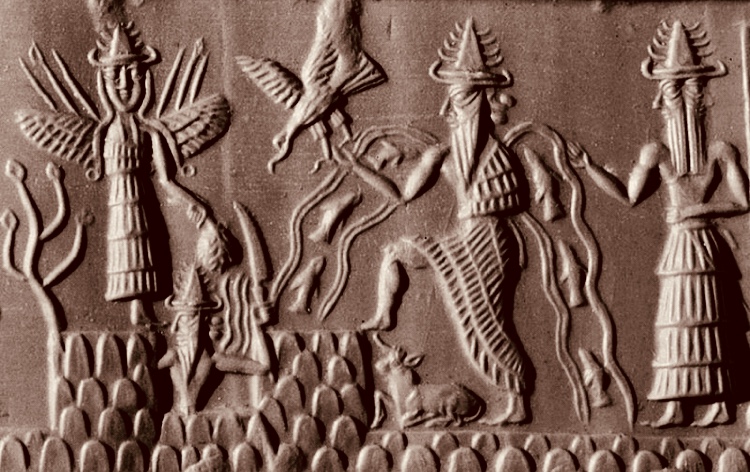
The Adda Seal, an Ancient Akkadian cylinder seal showing (from left to right) Inanna, Utu, Enki / Ea (with water issuing from his body?), and Isimud (c2300 BC)
However, one difference between Ptah and Khnum, and Enki and Poseidon is that Ptah and Khnum were said to be self created, whereas Enki had parents, Anu and Nammu, and Poseidon's parents were Cronus and Rhea. What parents did Ptah and Khnum have? They had none. Rather, they came out of Nun/Nu, the primeval waters.

Nu Hieroglyphics- pot phonogram nw / nu (x3) + "sky, heaven" pt (not spoken) + three wavy lines "water"
Nun / Nu was also one of the oldest of the Egyptian gods. His name meaning "primeval waters", but also associated with the forces of chaos; waters of chaos. We can maybe view Nun as the "deep, waters" of as referred to in Genesis.
In the beginning God created the heavens and the earth. The earth was without form and void, and darkness was over the face of the deep. And the Spirit of God was hovering over the surface of the waters [Nun]. Genesis 1:1-2

Another Egyptian goddess, Nut / Nuit, also had a pot for her symbol, not unlike Khnum, which she was depicted wearing as her crown. Whereas Khnum's hieroglyph is a large water jug (ẖnm), Nut's is a smaller spherical pot (nu) as is used in the hieroglyph for Nu / Nun.

Nut literally wearing her name on her head, a (nw / nu) "pot"

Nut Hieroglyph: "Pot" nu / nw + "bread bun" phoneme t [indicates feminine gender] + pt "sky" [not pronounced] + seated goddess
Nun represented the many / infinite waters of heaven, and Nut which was written with one pot (nu) represents our particular sky / heaven / pt; one container or pot of water(s), our part.
Nut / Nuit / Nwt was the goddess or personification of the sky / heaven. She was often depicted as a woman of the night sky, with stars covering her body arching over the heavens. She was also sometimes depicted wearing a water-pot crown, identifying her by her hieroglyphic name symbol, (nu / nw) the pot / vessel. So, there is the conceptualization of the sky being a container of the waters of heaven in the form of a water-pot.

Goddess Nut [detail] depicted as the starry sky arching over creation as the vault of the heavens, Ceiling of tomb of Ramses VI, Valley of the Kings, 12th century BC
The barque of Ra traversed these waters of the heaven every day. He (Ra / Re the Sun) entered the body of Nut through her mouth in the evening and was reborn every morning after traveling the perilous journey through the hours of the night in the underworld with Khnum as one of his protectors.
[Khnum] Considered to be the ba of Re - this might be an Egyptian pun on the fact that the ram was also called ba - he helped Re travel through the underworld each night on the Solar Barque. In the pyramid texts (Utterance 300), the barque was referred to as the "Ikhet Barque wich Khnum made", so not only did he defend the barque, but Khnum was thought to have created it as well. In this form he was often called Khnum-Ra and wears the sun disk of Re. by Caroline Seawright -Tour EgyptSo this idea of Khnum as Lord of the Water can perhaps be likened to a captain of a ship; one who masters the waters, and brings order to (defeats) the chaos of the waters [symbolized by the serpent Apep / Apophis (Greek)], whereas Nun is the water/s.

Captain Khnum on the Solar Barque

Julius Schnorr von Carosfeld 1819 - The Wedding Feast at Cana - six knum (jars) filled with water
This concept of living water is a concept that comes up in many spiritual traditions such as this passage from the bible. In Hebrew it is, mayim "water, waters" chayim "living", or in Aramaic (the language the conversation would have probably taken place in), mia chi.
A woman from Samaria came to draw water. Jesus said to her, "Give me a drink." (For his disciples had gone away into the city to buy food.) The Samaritan woman said to him, "how is it that you, a Jew, ask for a drink from me, a woman of Samaria?" (For Jews have no dealings with Samaritans.) Jesus answered her, "If you knew the gift of God, and who it is that is saying to you, 'Give me a drink,' you would have asked him, and he would have given you living water." The woman said to him, "Sir, you have nothing to draw water with, and the well is deep. Where do you get that living water? Are you greater than our father Jacob? He gave us the well and drank from it himself, as did his sons and his livestock. Jesus said to her, "Everyone who drinks this water will be thirsty again, but whoever drinks of the water that I will give him will never be thirsty again. The water that I will give him will become in him a spring of water welling up to eternal life." The woman said to him, "Sir, give me this water, so that I will not be thirsty or have to come draw water." John 4:7-15When viewed in this light, this type of "water" seems to be imbued with some sort of supernatural power or magic.

Heka - photo by Julie O. /chthonickore
Heka / Hike was the ancient Egyptian god of magic and medicine, and said to be son of Khnum. His name is identical with the Egyptian word translated as "magic," heka. He was also one of the primordial gods, or "powers," who enabled the act of creation and sustained life.
Heka was the manifestation of heka (magic) which should be understood to be natural laws which today would be considered supernatural but, to Egyptians, were simply how the universe functioned. The gods provided the people with all good gifts but it was heka which allowed them to do so. Ancient History Encyclopedia: Egyptian Gods - The Complete List
Egyptian doctors (known as Priests of Heka) were not trying to trick a patient with some slight of hand but were invoking real powers to effect a cure. This practice (heka) called upon the deity which made (Heka) as well as the other gods who were thought to be especially helpful in whatever disease they presented itself. Egyptologist Jan Assman explains:
"Magic in the sense of heka means an all-pervading coercive power - comparable to the laws of nature in its coerciveness and all-pervadingness - by which in the beginning the world was made, by which it is daily maintained, and by which mankind is ruled. It refers to the exertion of this same coercive power in the personal sphere. (3)"
In medicine, the laws of nature as personified by the gods were invoked in order to cure a patient, but heka was also practiced in many other areas of one's life and, often, in the same way. Ancient History Encyclopedia, HekaThe hieroglyphic spelling of Heka includes the word ka the "vital force", one of the parts of the soul in the Egyptians' complex view of the soul. One of Heka's titles was "He who activates the Ka". It is Khnum who was said to be responsible for creating a person's Ka, and Khnum was also known as the father of Heka.

Heka hieroglyph - phonogram h "wick, twisted flax" + ka "upraised arms" + seated god / neter (determinative)
It is interesting that we have these words in other languages having to to with magic or the occult which seem to relate to this word for magic, such as hex "to cast a spell on; practice witchcraft", from German hexen "to hex"; hexerei "witchcraft, wizardry, sorcery"; die hexce "witch"(f.)[pronounced hexa]. However, the etymology of the word hex is said to originate from Middle High German hecse, hexse, from Old High German hagazussa "presumably" related to the origin of the word hag, and this word "hag" itself said to be "probably" from the Old English hægtes "witch, sorceress, enchantress, fury," which is from Proto-Germanic *hagatusjon . . . which is itself of unknown origin,
The first element [hag] probably is cognate with Old English haga "enclosure, portion of woodland marked off for cutting." [OE]However, it still seems very likely that the words, hex and hag, could have been somehow intertwined or influenced by this most important ancient concept of "magic", i.e., heka from Egypt.
This idea of "enclosure" has very much to do with magic. So a hag could be someone who deals with these sorts of things, i.e., haga (enclosure). A witch (hexce) is a circle drawer. In this sense we might say a witch is a hedge (n.)[related to OE haga] writer as well as a hedge ridder.

The Magic Circle - John Williams waterhouse, 1889, London
In ancient Egypt protective circles were called shen (šn/pl. šnu) "circuit, ring". What we call cartouches are elongated shen rings which encircled names to offer protection to the individuals. The shen (cartouche) as a hieroglyph also came to be used to represent the word "name".

Cartouche of Hapshepsut (1507-1458 BC) - on obelisk, Luxor, Egypt
The father devised the name. I have many names, many, forms, he whose form is in every god, who is called Atum-Horus-Hekenu. My father and my mother told me my name and I hid it from my children, in my body to prevent it happening that a male or female magician (heka) strike against me. –paragraph 5
Then said Isis to Ra: 'Tell me your name, my divine father. A man lives when called by his name.' –paragraph 8
Then said Isis to Ra: 'Your name is not among those you have told me: tell it to me. The poison leaves a man when his name is pronounced.' –paragraph 9
The makers of these name enclosures (and other protective amulets) would have been the practitioners of heka. We might call a shen ring then a heka circle; a "magic circle."

Shen Ring - from Global Egyptian Museum
"You don't know what you are asking," Jesus said to them. "Can you drink the cup [potérion in Greek "drinking cup" or "portion that God has chosen" ] I am going to drink?" "We can," they answered. Matthew 20:22The shen ring itself has certain resemblance to an inverted nu "pot" hieroglyph. A pot seems to be somewhat like a 3D representation of a shen. And Nut the goddess does in fact represent our heaven / sky or enclosure. So we could say Nut is a powerful haga (enclosure). She is in fact this "pot" that is a magic circle that is our dome, i.e., domicile, home.

A Nut-like image of the night sky, or the Nuit sky
Our universe is basically a Nut-house.
The word magic comes from *magh- "to be able, have power," so this word is pointing to something, or someone who is potent and powerful, not just someone performing mere tricks and illusion. It is ironic that people whom we call magicians today are actually using science and not magic. They use knowledge of sciences such as optics, to create illusions (smoke and mirrors), and / or they become good with physical feats and tricks, such as sleight of hand, etc., however, this is not heka. As far as doing magic, they are really just fibbers. A real magician is someone who is actually able to accomplish things (as they are claiming) and have power using the more occult / hidden or misunderstood forces of nature.
Magic in the sense of heka isn't fake. And so it also isn't differentiated from the force, or way by which the gods, are able to perform "extraordinary" or healing tasks; what we might today call "supernatural".

Moses, with Aaron and Hur assisting, performing heka by the direction of the LORD (YHWH), holding up his arms (Ka) during the Battle of Rephidim - John Everett Millais, 1871
"As long as Moses held up his hands, the Israelites prevailed, but whenever he lowered his hands, the Amalek prevailed." Exodus 17:11The use of the word supernatural meaning "of or given by God," came into use around the early 15c, from Medieval Latin supernaturalis "above or beyond nature; divine." However, heka "magic" wasn't considered to be beyond the natural in the sense that it came out the order of the universe and was used to create the universe. Heka was available to all, to gods and to people (although not all were learned or good practitioners of heka). So in this understanding there isn't really a distinction between magic and miracle.
All miracles "wondrous works of God," are accomplished through the use of this kind of magic. And the more magh, the more poti the practitioner, the greater the work will be. A very magnificent magician might make matter with merely a mutter . . .
And God said, "Let there be light," and there was light. Genesis 1:3The use of magic / heka, i.e., causing something to be such as it is, is often accomplished through a intimate understanding of the nature of creation; working with or being in touch with / in the right relationship with, both the seen and unseen, the apparent and hidden forces of nature at every level. Unknown and unseen forces, are just as much a part of the equation as the known or established known (scientific). Just because something is not known or recognized as a cause, does not mean it is not in play.
The science of a thing doesn't need to be fully understood in order to accomplish results. In other words, we are able to come to a certain kind of practical truth and use tools even without really knowing what we are doing. In this quote from Terence McKenna, this point is illustrated with the term "model".
. . . In the 20th century a slight epistemological sophistication leads to this word "models", where we say we are "modeling" reality. And our model is only good as we need it to be. If we are trying to model the flight of an artillery shell, the model needs to be only good enough to get to the artillery shell to its target. We don’t need to understand the essence of lead, or the nature of motion there, we simply need the model to kick out the data that interests us . . .
Then when we ask the question, "Can we know the truth?" in instances like this we say,
. . . It is true enough. —Excerpts from audio of Terence McKenna(1946-2000) on why there is congruence between the mental world of human beings and the world of abstract mathematics and the world of nature. YouTube link here
We make use of models and other tools all the time. Our tools can be scientific (that is understood), or magical (occult). And sometimes, even, what is scientific to one person seems occult to another. For example, people use a wonder of science every single day, a tool called a smartphone. However, most people have very little or no clue as to how it works, yet it allows them to do a myriad of extraordinary things that were yesterday's science fiction, such as video chats, immediate access all sorts of calculators, weather predictions, time keeping, etc. If someone was asked if they know how their smartphone works, they might say "yes", because they know enough, they know how to make it work for their purposes, but how it is actually operating may as well be by magic. We are constantly acting on our experience of what is “true enough”.

"Let there be light!" With my magic wand "finger" I touch the magic screen icon and raise the light level. –screenshot by Julie O.
The practitioners of heka, were intimately connected with medicine as well. Someone who is concerned with healing is concerned not only mapping out a science, but also with creating outcomes. It is of the utmost importance for medicine to be effective. It is a matter of life and death. So, if by practicing "magic" certain results of health are achieved it is definitely a part of medicine.
In Latin medicus "physician," is from,
medeor "to cure heal," originally "know best course for," from an early specialization of PIE root *med- "take appropriate measures". [OE], medical

Medical tools and measures -photo by thecollectiveinvestor.com
Which is interesting because, given the particular pronunciation of "med", it can sound very similar to "mat", and Maat / Ma'at / Mayet was the primordial ancient Egyptian goddess and concept of truth. Maat created, or was the order created out of chaos at the beginning of the universe. Maat was the foundation (mat) or platform upon which creation rested. Maat also included the concept of justice and balance. A person's heart was weighed, or we could say measured (from past participle of Latin metiri "to measure," so in a sense it was meted (maated) against the feather of Maat after death. If the measure of the heart of the deceased against the feather (maat) was not just, the punishment was meted out not by Maat, but rather, Ammut / Ammit the "Devourer of the Dead," thus suffering the second death. What Maat was mattered. To consider or honor Maat is to med- "take appropriate measures".

Ma'at wearing her symbol, ma'at(Ostrich Feather)
The practitioners of heka would be very much concerned with this notion of "truth" in order to determine the best and effective courses and appropriate measures to bring about the health of mind, body, and spirit. So perhaps we might call them maatics (medics) with maatical (medical) knowledge. However, their knowledge went beyond the strictly medical. Whereas Maat was more this weighable, measurable, mathematical or scientific truth, Heka was the more occult (hidden / concealed) forces or workings underlying creation. What is not immediately apparent. And what do we do when we don't know? We raise our arms. What the Heka?

Ka
The best medicine would definitely include knowledge of both the seen and unseen, tangible and intangible forces and causes in order to be most effective. Anyone can practice medicine but if the practice is not bringing about the desired outcomes, then it isn't really medicine is it?
Medicine, other than being a practice, can also have the meaning of something like a drug or potion. Drinkable medicine is a kind of potion.

Liquid Medicine
Potion is defined as, "a liquid with healing, magical, or poisonous properties." So it can be a drug or tonic to cure disease, something such as a love potion meant to bring about a certain outcome not having to do with the health of the body, or it can even be meant to effect the opposite of health, i.e., a poison. Both potion and poison come from the same ultimate root as potable, PIE root *po(i)- "to drink". They are things to be drunk. They are drink.

Potable Poison / Potion - photo by Julie O. /chthonickore
Potion is taken from the Old French pocion, and is from Latin potionem (nominative of potio) "a potion, a drinking," also "poisonous draught, magic potion." Poison is "a deadly potion or substance (c. 1200)," also figuratively, "a drink" from Old French poison / puison, as in when we say, "Pick your poison," we mean to choose a drink, but not a drink that is going to kill you / deadly. However, it is true that "drinks" like alcohol or colas, etc., are more or less "poisonous" or dangerous, unlike plain water. Even medicine or medicinal drinks can harm as they help and we have to weigh the risks. Is the cure worse than the disease? Are the side effects acceptable?
"I know what you want," the witch said to her visiter. "You want to be rid of your fish's tail, and have legs so that the young prince will fall in love with you." She gave a repulsive laugh and added, "I will prepare a potion for you that will make your tail disappear, and shrivel up into what human beings call legs. But every step you take will be like treading on sharp knives. If you put up with sufferings like these, I have the power to help you." –Little Mermaid, Hans Christian AndersenPreferably, medicine is helpful and not with harmful side effects. The best potion is least poisonous and most potable. Like water itself. Pure clean water, and maybe even water imbued with some heka. Not all water is equal.

Water made more potent / potable by the vibration of positive sigils -photo by Julie O. /chthonickore
Such as the regenerative waters of Nun.
The sixth hour of the night (midnight) contains the main and focal moment of the Amduat: the actual moment of the renewal of Re with the reunion of his ba-soul with his corpse, described in the text as the union of Re with Osiris. Re's solar bark has left the desert land of Sokar and entered a new region, deeper, darker, called the 'waterhole of those of the netherworld' where the presence of the primeval ocean Nun offers the necessary regenerative powers to start a new life. - Section of the papyrus belonging to Nesmin, with the sixth hour of the Amduat c. 300 - 275 BC, Royal Collection Trust
These waters are potent; a powerful potus or potion. But why? What is it about the water that causes regeneration? Is it science? Is it magic? Is it a miracle?
What happens when we look closer? What if we look to its smallest particles, or might we say the Ptah-cles? The smallest material arising out of nothingness,
or the fundamental building blocks.

An Artist's rendering of an Atom
Ptah is known as the primeval mound, and Khnum is the builder. We can think about these neteru at the microcosmic level as well as the macrocosmic. Matter is actually made up of not smaller and smaller pieces of matter, but rather, at a certain level it is made up vibration. A "first thing" arises at some point which is not built from other matter, but which itself forms the basis for matter, such as what we call atoms (from Gk "uncut; indivisible"). But of course we can go even farther to describe subatomic particles; the protons (from Gk "first"), neutrons, and electrons. And, at an even smaller level protons and neutrons themselves are made up of smaller elementary particles called quarks.
An ordinary proton or neutron is formed of three quarks bound together by gluons, carriers of the color force. Above a critical temperature, protons and neutrons and other forms of hadronic matter 'melt' into a hot, dense soup of free quarks and gluons, the quark-gluon plasma. LiveScience, 7 Strange Facts about QuarksNow that sounds like a primeval ocean!
Fundamentally, however, matter is said to be made out of atoms as the building blocks such as hydrogen which is one atom made up of a single + proton and - electron bound together. These elementary particles get together and vibrate . . . and when things vibrate we get waves. On the level of quantum mechanics there is an ambiguity between particles and waves. These particles are not simply particles. Particles such as photons and electrons act like both particles and waves. Perhaps Ptah and Khnum are Lords of these waters / waves as well.

Vibrational Waves
The "primeval waters" of the universe are ordered (vibrated) in certain ways to create. When God speaks (vibration) into the waters, light (which is waves) come to be. So we can say God creates out of Nun (the primeval waters), but Nun is not entirely nothing. It is something that vibration (speach) can be applied to to create. So this "water" has potency, or maybe we could even say IS potency. And it has the potential to be shaped . . .
On the microcosmic level, bringing order to the waters and creating / fashioning / shaping we might call tuning. In this sense we could say that the Divine Potter tunes us into being from the matter that is created from vibration. Tune is a variant of tone, from Greek tonos, originally "a stretching." A tuner of a stringed instrument stretches and relaxes the strings to get the correct tone, and a potter is said to "pull" clay to shape it, so these concepts are not altogether unrelated.
Both Ptah and Khnum, the Divine Potters, are often portrayed holding was / uas scepters, which when you look closely have an odd shape that resembles a tuning fork / key at the base. Was / Uas as a hieroglyph had the meaning "power, dominion".

Khnum holding Was Scepter and Ankh - base relief Temple of Seti, Abydos, Egypt
Thou dost (rule / break) them with a (scepter / rod) of iron, as a (potter's / maker's / fashioner's / creator's) vessel thou shalt dash them. Psalm 2:9Vibration has the power to form and shape. And sometimes the vibrations produce waves which are so strong they can break things (such as glass) or break things apart (such as bridges). Think of that Lord of Water, Neptune, god of earthquakes.
We see that different frequencies of vibrations produce universal set patterns. These patterns then are dictated by the universe (the creator) and create what is.

Cymatics in water - from Kyma 'wave" in Greek
The set patterns dictate what is, and since creation is good, we could say that sickness is anything deviating from the designed plan, and that which conforms or is vibrating in harmony with the plan or law of creation would be healthy. So we could say the potable water, the drink, given by the creator, i.e., the living water, may better be called the "living waves" providing good vibrations or health.
These "waves" issue from Khnum, as a kind of nomos ("law" in Greek). The Greek term for the provinces of ancient Egypt was nome, from the same. Each nome had its own totem or symbol, so we could say the symbol of each nome was in fact the name (Old English nama, noma), given the nature of hieroglyphs. Maybe this concept of the Divine Potter as Khnum / ẖnmw, is related to these similar sounding (vibrating) words. In that case we could think of these waves or the living water as issuing from the god who names (Khnum), i.e., who is the vibration (waves) that creates everything and makes things and people who and what they are, and wholly / truly themselves, whole and healthy.
But now, thus says YHWH, who created you Jacob, and [*the potter] who formed you Israel, fear not for I have redeemed you. I have called you by your name and you are mine. Isaiah 43:1 [* from yatsar ]
Remember it was YHWH who gave Jacob this new name, Israel. Perhaps the meaning here could be that YHWH created [bara' in the sense of hewn / cut] him as Jacob but then fashioned [yatsar] him into Israel (at their encounter when Jacob wrestled with God), as the Lord of the Waves, as the puller of these waves, ẖnmw, the namer, the yatsar [creator / fashioner / potter], Jacob was [re]fashioned Israel. So, hnmw, gave Jacob his new vibration, and the new vibration is a new law (nomos), and therefore a new name (onouma)
Whoever has ears, let them hear what the Spirit says to the churches. To the one who is victorious, I will give some of the hidden manna. I will also give that person a white stone with a new name [onouma Gk] written on it, known only to the one who receives it. Revelation 2:17
Another word for "name" in hieroglyphs is rn. It is the r "mouth" hieroglyph over the n "water wave" hieroglyph. So the word "name" is represented by the (water / wave) vibration from the mouth, as well as the shen, i.e., the pot shaped enclosure.

This seems to lend validity to the idea that the Egyptians considered speech / vibration to be a type of water (remember the three waves hieroglyph is said to mean all of these things, water=wave=to drink=to wash) And the Lord (Poti) Potter uses this water to create, as the goddess ist (Isis) uses it to heal. The rn "name" is truly a rune, from Old English run, rune "secret, mystery, dark mysterious statement, (secret) council."
pry tA mtwt s dm.tw rn.f
The poison leaves a man when his name is pronounced. A Ramesside Incantation to remove poison from a patient, Isis and the name of Ra, Midddle Kingdom
The centurion replied, "Lord, I do not deserve to have you come under my roof. But just say the word [logo / λόγω] and my servant will be healed. Mt. 8:8
Creation is a dark mysterious statement. All that is, was, and ever will be was fashioned in a single moment, or named in a single Word of perfection. It is this concept that allows for magic. There is a single template (the Logos / Word / OM) we are traveling in, around and through at every moment. It is because of this fixed reality of ordered infinity that we get magic (heka) as the offspring of the omnipotent creator of the universe. An unmagical world is not the product of an omnipotent Magh-ician. Magic is the result of the self similarity and nature of oneness which makes up the universe. The image which is creation at all levels (both the macrocosmic and microcosmic levels) is perfect and can never be compromised or altered in any way fundamentally. It is an image of the ALL.

Cosmic Christ - The Living Water / Waves / Potus which causes health
I believe in one God, the Father almighty, maker of heaven and earth, of all things visible and invisible. I believe in one Lord Jesus Christ, the Only Begotten Son of God, born of the Father before all ages. God from God, Light from Light, true God from true God, begotten, not made, consubstantial with the Father; through him all things were made. For us men and for our salvation he came down from heaven . . . – Nicene Creed
Therefore to know anything is, in a sense, to know everything. Or, we could say, to really know any one thing is a tool, or a truth that can be applied to know, or accomplish other things. This is how the magical can supersede or supplant, at times, our limited science and scientific knowledge. Sometimes we come across ways of accomplishing outcomes without being able to explain how they are working, but they do work. And they work because of the fundamental unity of all things.
To again quote Terence McKenna (earlier in his talk),
. . . Processes always occur in the same way and this is why there is congruence between the metal world of human beings, and the world of abstract mathematics, and the world of nature. These things are, as it were, simply different levels of condensation of the same universal stuff. This is why the concept of truth can have some meaning. Terence McKenna

I Am . . .
Your name is important. Your true name is a type of "living water," a vibration that shapes you into the best / healthiest version of yourself possible.
What is your name of power?
This is who you are.
This is who you are.
This is who you are.
Magic!