Wisdom is the state or condition, i.e., "-dom" of being wise. Wise is from Old English wis "learned, sagacious, cunning; sane, prudent, discreet; experienced; having the power of discerning and judging rightly." From Proto-Germanic *wissaz, from PIE root *weid- "to see" 👁👁 (hence "to know" 🐍). In certain decks the High Priestess is called "the seer."

Whereas the magician is *magh-, i.e. "powerful" and shows skill and ability in an outward extroverted way, wisdom is the more mysterious and subtle force working behind the scenes. She is the other, second, two, II. However, this does not diminish her dignity. She is the necessary hidden foundation of everything.
The LORD brought me forth as the first of his works, before his deeds of old; I was formed long ages ago, at the very beginning, when the world came to be. When there were no watery depths, I was given birth, when there were no springs overflowing with water; before the mountains were settled in place, before the hills, I was given birth, before he made the world or its fields or any of the dust of the earth. I was there when he set the heavens in place, when he marked out the horizon on the face of the deep. . . Proverbs 8:22-27
If one wants to be a powerful magician, wizard, or wiseman [like Solomon] he must respect wisdom and this image of God she represents.
For wisdom is more pure than any motion; because of her pureness she pervades and penetrates all things. For she is a breath of the power of God, and a pure emanation of the glory of the Almighty; therefore nothing defiled gains entrance into her. For she is a reflection of eternal light, a spotless moirror of the working of God, and an image of his goodness. Wisdom of Solomon 7:24-26
With thee is wisdom, who knows thy works and was present when thou didst make the world, and who understands what is pleasing in thy sight and what is right according to thy commandments.
Send her forth from the holy heavens, and from the throne of thy glory send her, that she may be with me and toil, and that I may learn what is pleasing to thee. For she knows and understands all things, and she will guide me wisely in my actions and guard me with her glory. Then my works will be acceptable, and I shall be worthy of the throne of my father. For what man can learn the counsel of God? Or who can discern what the LORD wills? Wisdom of Solomon 9:9-13
In Greek Wisdom is Sophia Σοφία, from sophia σοφία meaning "skill, knowledge of, acquaintance with; sound judgement, practical wisdom; cunning, shrewdness, philosophy, from sophos 'wise'. This would make her quite sharp (as in smart).
We might compare this word, Sophia, to the ancient Egyptian name of the goddess Sopdet Spdt. Her name meaning "sharp" one / woman, or "skilled" one. Her name was written (most often) containing the same triangular hieroglyph used as a determinative in the word srt [seret] 'thorn'). It also had the meaning spd "sharp"(and other related words such as "skill" which is said to be from PIE *skel- "to cut").
 |
| Sopdet / Spd, a few different spellings |

Gardiner's Sign-list of Middle Egyptian
The Greek rendering of the Egyptian, Sopdet, was Sothis Σόθης. If a Greek feminine ending, 'α' sound, is added to either name, they would be Sopdia [replacing the ancient Egyptian feminine gender specification 't' ending] or Sothisa, respectively, which are both similar sounding to Sophia.

Sopdet was the personification of the star known as Seirios Σείριος "glowing," "scorcher" to the Greeks, from which we get the name Sirius, by way of the the Roman rendering of the name. Sirius is the brightest star in the sky.
To the ancient Egyptians her [Sopdet's] heliacal rising in July heralded the New Year and the very important life bringing inundation of the Nile (that is, when the land got sopped with the fertile water of the river). However in the Mediterranean region of Greece and Rome, Sirius, "the Dog Star" (of the constellation of Canis Major), also heralded the hot and disease bringing "dog days of summer".
Sirius rises late in the dark, liquid sky / On summer nights, star of stars, / Orion's Dog they call it, brightest, / Of all, but an evil portent, bringing heat / And fevers to suffering humanity. Iliad, Homer, Book 22, 33-37, translation Stanley Lombardo
That is quite a serious accusation! This star had a bit of a thorny or 'seret' -ed reputation. And the the look of dog's teeth do have something in common with the serrated notches of the teeth of a saw blade. Acording to Ancient Egypt Online, "The sign itself was called 'the tooth' by the ancient Egyptians . . ." Therefore, this 'tooth' would have been visually represented in the name/spelling of the "Dog Star," the goddess Sopdet (Sirius). And the thorn hieroglyph does look similar to a pointed tooth of a dog.
 |
| Canine Teeth – srt/spd hieroglyph |
And things that are pointed, acute, peaked and sharp are often found at the top, or are the best in some way and therefore leaders. This idea was discussed in a previous Etymological Odyssey entitled "I said I was Sorry".
The notches on saws are like mountain peaks, such as the Sierra (from Latin serra "saw") Nevada mountains. These peaks are sharp looking. Peaked mountain tops are chief among mountains, being the highest. see horns: Be Fruitful and Multiply
In biblical Hebrew sar is "chief, ruler, official, captain, prince," and sarah is "noble lady, princess." Compare this to, Old English sar (wounding), Proro-Germanic *saira (suffering), and *sairaz (pain). Why would "ruler" and "noble lady" have an association with suffering, sickness or illness? Chthonic Kore, I said I was Sorry
We would definitely say that the Goddess Sopdet is sarah a "noble lady"and also the brightest; the "chief" star, "star of stars," Sirius. And in fact she was syncretized in later time periods with the great goddess Isis (Gk.) Ισις / Aset, ꜣst, consort of Osiris, ressurected god of the underworld whom the ancient Egyptians associated with the stars of Orion. The stars of Orion's Belt (Osiris) point to Sirius (Sothis-Isis) which is in close visual proximity due southeast. Isis was an important goddess from the time of the Old Kingdom to the Ptolemaic Period, and through to Roman times, who took on characteristics and attributes of other goddesses. Isis is goddess exemplar, quite a star. Below we see a Roman bust of Sothis-Isis-Demeter.

The name of Isis, aka, Aset, was spelled with the throne hieroglyph st meaning "seat, place" in ancient Egyptian.

And she was is fact the seat (throne) of Horus in her portrayal as the nursing mother goddess.

The High Priestess bears this throne (Isis) imagery in the tradition of the Rider-Waite Tarot (below). She is seated and wearing a similar crown, of cow horns and sun disk (which is the crown of Hathor, ḥwt-ḥr, the nurturing mother goddess / celestial cow, whose name has the meaning "House of Horus").
The High Priestess here also shares imagery with the wisdom of the Old Testament, which in Hebrew is chokmah. Here she is Wisdom sitting or enthroned at her gates, i.e. pillars. The pillars Boaz and Jachin stood on either side of the steps of the entrance of Solomon's Temple, and as such, would have defined the entrance. So they both visually and energetically created an "opening" or "gateway" to the temple. They were decorated with lillywork and pomegranates as attested to in 1Kings 7:15-21. Inside the temple itself was housed the Arc of the Covenant.

Chokhmah / Wisdom speaks here in this passage from Proverbs,
Now therefore, my sons, listen to me: blessed are those who keep my ways. Listen to instruction and be wise [chakam]; do not ignore it. Blessed is the man who listens to me, watching daily at my doors [deleth (collums, gates)], waiting at the posts [mezuzot] of my doorway [pethach (opening, entrance, gateway)]. For whoever finds me finds life and obtains the favor of the LORD. But he who fails to find me harms himself; all who hate me love death. Proverbs 8:32-36
In the Spolia Tarot [below] we see The High Priestess connected to snake symbolism.

The snake was a symbol for the goddess in ancient Egypt. The goddess Wadjet, was represented by the iaret "rearing cobra," called the uraeus "on its tail" by the Greeks, and was often portrayed in artwork, statuary, amulets and jewelry, and was worn upon the brow of pharaohs in this form.


The goddess as represented by the snake, shows a certain duality to her nature.
The Eye of Ra also represents the destructive aspect of Ra's power: the heat of the sun, which can be so harsh that the Egyptians sometimes likened it to arrows shot by a god to destroy evildoers. The uraeus is a logical symbol for this dangerous power. In art, the sun disk image often incorporates one or two uraei coiled around it. The solar uraeus represents the eye as a dangerous force that encircles the sun god and guards against his enemies, spitting flames like venom. Four uraei are sometimes said to surround Ra's barque. Collectively called "Hathor of the four faces", they represent the eye's vigilance in all directions Eye of Ra: Aggressive and Protective, wikipedia
Wisdom is good, however, in sharing her keen knowledge, she can seem to bite with the sharp sting and fire of venom, like the seraph "fiery serpent" snakes of the Old Testament that bit the Israelites in the wilderness. Thus, Wisdom, can be the cause of serappim "disquieting thoughts" (or we might say "cognitive dissonance," which in severe cases can lead to psychosis and/or suicidal ideation).
I remember when — I remember — I remember when I lost my mind — There was something so pleasant about that place — Even your emotions had an echo, in so much space — And when you're out there without a care — Yeah, I was out of touch — But it wasn't because I didn't know enough — I just knew too much . . . Does that make me crazy? –Crazy[lyrics], Gnarls Barkley
Even Jesus, who called himself "The way the truth and the life" John 14:6 says of himself, "I have come to cast fire upon the earth; and how I wish it were already kindled! Luke 12:49. The truth is not always all fun and games. It can be downright terrifying!
So, yes, Wisdom can appear as generally snakey... snakey like the serpent in the garden of Eden, whom God allowed leave to trick his poor unsuspecting innocent creations into partaking in the produce of, or product/consequence of ingesting the knowledge (da'ath) of Good and Evil.
Nao teh snakez wuz mor shneakay den any beest ov teh field (or hows) which Ceiling Cat had maded. Genesis 3:1, The LOLCat Bible
Wisdom can be snakey, bringing about a fall just by her very nature, i.e. causing one to see, or know.
"For God knows that when you eat from it your eyes will be opened [or, will be wide open, *weid- "to see" open 👁👁🐍], and you will be like God, knowing good and evil."
When the woman saw that the fruit of the tree was good for food and pleasing to the eye, and also desirable for gaining wisdom, she took some and ate it. She also gave some to her husband, who was with her, and he ate it. Genesis 3:5-6
The knowledge of Good and Evil (i.e. the knowledge that makes one like God) entails the experience of the duality which is present in creation by nature of being fashioned in wisdom.
For she is an initiate in the knowledge of God, and an associate in his works. If riches are a desirable possession in life, what is richer than wisdom who affects all things? And if understanding is effective, who more than she is fashioner of what exists? Wisdom 8:5-6
The truth of the matter is that both good and evil exist, or we might more properly say, both "the good" and "the adverse" exist in God's creation. In/ through/ and with wisdom God created this Day which contains both the light and the dark; the night and day.
God called the light "day," and the darkness he called "night." And there was evening, and there was morning—the first day. Genesis 1:5
... and God saw that it was good. Knowledge, too, like the Day, is good, but partaking in it doesn't necessarily produce pleasurable or pleasant outcomes in the short term. Sometimes the truth hurts and ignorance is bliss. Yet, there is a certain alluring appeal to this magical wisdom that creates good from evil. And, finally, in the end... after the fall / death, there is rebirth and resurrection, the glory of the morning; morning, that is nothing other than day, but specifically 'day' that has been preceded by the night. Day, night, morning (day) = one day.
O felix culpa quae talem et tantum meruit habere redemptorem.
Oh happy fault that merited such and so great a redeemer. - Exultet of the Easter Vigil
A "new creation" emerges out of the old skin. Wisdom encourages growth which is good, but growth can be scary and painful. Shedding the old skin literally leaves one naked and vulnerable for a period of time. There is a certain acuteness involved with the acquisition of wisdom.
However, Wisdom, also seems to provide, or be herself, the remedy for her own dis–ease (serappim).
When the Israelites were dying from being bitten by the seraphim nachashim, "seraph; fiery serpent" serpents in the wilderness,
The LORD said to Moses, "Make a snake[seraph] and put it up on a pole[nes "standard"]; anyone who is bitten can look at it and live." Numbers 21:8
The "standard" in ancient Egypt was the hieroglyph used to indicate deity. So the seraph on a pole would doubly indicate its purpose in reprenenting the power of God. And Jesus, who is compared to this savior serpent of the Old Testament in John 3:14, exhibits this same kind of duality in his mission as well. Jesus brought the good news "Gospel", but he was also trouble riding in on an ass.
And Jesus when he had found a young ass, sat thereon; as it is written
"Fear not, daughter of Sion: behold thy King cometh, sitting on an ass's colt." John 12:14-15, KJV
But look what happened to him and his deciples. Some King! The disciples of Jesus received his "good news" and were subsequently killed for it. And when they were hiding out before Jesus reappeared to them, they must have wondered if evil had indeed triumphed.
But, it seems that people need a savior figure, an idol, a star to look up to, someone or something physical and real to believe in and focus the mind. Clearly "idols" as such are not bad, otherwise why would God have told Moses to make a "fiery serpent" and set it on a pole to save the people? Why didn't he just tell them to ask God, their father in heaven, to heal them, and then heal them? Instead they were given a material image of the goddess, if not specifically, then, for all intents and purposes very much like, the serpent goddess of ancient Egypt, Wadjet, the iaret "the risen one," Uraeus.

Idol from its etymology, is simply a "material image" or likeness of a thing, from Greek eidolon, from eidos "form, shape; likeness, resemblance," which is related to idein meaning "to see," eidenai "to know;" literally "to see" (from PIE *weid-es, from root *weid- "to see"). Was this a wise (also from *weid-) thing for God to do? God instructed Moses to make an eidolon. And at first it was in fact effective, or we could say, the idol proved to be NOT idle.

The people put their faith in it and whoever looked upon it was saved. So it would seem that what is actually bad "idolatrous" is worshiping a "god" who is idle. For when the Israelites persisted in giving deference to this same idol of a bronze serpent after its purpose and efficacy had ended, it needed to be destroyed. They were worshiping an idol, a fallacy.
He [Hezikiah] removed the high places and broke the pillars and cut down Asherah. And he broke in pieces the bronze serpent that Moses had made, for until those days the people of Israel had made offering to it (it was called Nehushtan ["bronze one"]). 2 Kings 18:4

Thoth was an ancient Egyptian god, skilled and crafty, credited as inventor of writing, language, the arts and sciences, all of which incorporated heka ("magic"), and presided as scribe at weighing of the heart ceremony, i.e. judgment of the deceased. The Greeks equated Thoth with Hermes. The pronunciation of his name transliterated from Egyptian as ḏḥwty is not certain. One rendering used is Djehuti, however the end sound may not have been pronounced as such, the Greeks wrote his name as Θώθ (theta, omega, theta) Thoth (also written as Thot or Thout), perhaps we could compare his name to the words thought and taught, as a devotee of wisdom, and teacher of writing, the arts and sciences.
Thoth was also associated with the moon.

The moon with its phases embodies and is symbolic of the organic feminine cycles of change and growth acting in creation, and is another common symbol found in many interpretations of The High Priestess.
 |
| Ibis headed Thoth with Lunar Crown, Kom Ombo Temple Complex |
In this relief above, Thoth is depicted wearing a moon-disk on his head. And he himself is depicted as a man with the head of an ibis. Ibis' were also connected with moon symbolism themselves.
... we can discover various grounds for the identification of an ibis-god with the moon-god. Erman (Rel., p.10) ascribes the transformation of the moon into an ibis to popular fancy which noticed resemblance of the curved beak of the ibis to the sickle-crescent of the moon. In the later periods of Egyptian speculation all kind of explanations of current religious symbols were devised. One of these finds an echo in Plutarch when he says (Is. et O. 75, 8) that the mixture of white and black in the plumage of the ibis remends[sic.] one of the waning moon. (I) It may be, too, that the Egyptians saw in the dignified flight and pose of the ibis, something of the majesty of the moon as it fared across the skies, or looked down silently on men. Thoth, the Hermes of Egypt, by Patrick Boylan, p.78

According to Theodore Hopfner, Thoth's Egyptian name written as ḏḥwty originated from ḏḥw, claimed to be the oldest known name for the ibis. Thoth: Name
If we go to the II trump of the Thoth Tarot by Alistair Crowley, she is The Priestess shown seated, holding up a matrix-like veil over her lap with raised and outstretched arms. The movement of her arms seems to have caused a swirling fluidic disturbance in the aether around her torso and head, as if her hands holding the net-like veil had been moved from the position of being crossed over her face to the outstretched and raised position they are in now, in one quick, succinct motion. Two pillars are apparent behind, and to either the side of the veil, which she is sitting between. She wears the Hathor/Isis crown with a series of moon crescents issuing upward across her face in rippled succession to the the top of her head, another moon crescent is below her feet. She wears lemniscate goggles. There is a bow and arrow resting on her lap under her veil. Crowly says of this, "Upon her knees is the bow of Artemis, which is also a musical instrument, for she is huntress, and hunts by enchantment." —The Book of Thoth, The Tarot of the Egyptians, p. 73

Here the Priestess provokes strong imagery of the ancient Egyptian primordial goddess called Neith / Nit / Net / Neit, the cosmic weaver and goddess of war and hunting, who was syncretized in certain periods with Hathor and Isis, and also shares certain attributes with the Greek goddess of wisdom, handicraft and warfare, Athena. Although Neith is the more primordial and enigmatic of the two.
Plato also comments on the link between Neith and Athena in his dialogue of the Timaeus where he writes, "The citizens [of Sais] have a deity for their founders; she is called in the Egyptian tongue Neith and is asserted by them to be the same whom the Hellenes call Athena" (21e.). Her identification as the most powerful creative force in the universe is noted by Plutarch (c. 50 - 120 CE) who writes that the temple of Neith at Sais held this inscription "I Am All That Has Been, That Is, and That Will Be. No Mortal Has Yet Been Able to Lift the Veil That Covers Me. [The Fruit Which I Brought Forth is the Sun ADDN]" It is interesting to note that her name, among many other connotations, links to the root word for "weave" which carries with it the meaning of "to make exist" or "create" or "to be". Neith: World History Encyclopedia
Both goddesses had association with serpents. Neith was depicted at times in the form of the uraeus. Her symbol is found on uraei such as in this example from the tomb of Tutankhamun.

"An inscription painted in yellow on the black pedestal describes the deceased Tutankhamun as 'beloved of Netjer-Ankh', which leaves no room for doubt that the name of the serpent deity was Netjer-Ankh meaning the 'living god.' A serpent with that name, or its variant Ankhnetjer, is represented on painted wood coffins found in middle Egypt and dating from some five centuries before the time of Tutankhamun; on the underside of its hood is the emblem usually associated with the goddess Neith, a feature also seen on the serpent in Tutankhamun's tomb." Netjer-Ankh, Tour Egypt
In certain myths Neith is also connected to the creation of Apep / Apophis (Gk.), the primordial serpent "Lord of Chaos," and two of Athena's symbols, besides the popularly known owl, are the snake and Gorgoneion (head with snakes), and both goddesses could be somewhat fearsome.

In this association with snakes we see a duality is again present. We see it also in their association with war. The same type of instruments that are used for weaving, i.e. creating, are also used for instruments of war. Here is a quote from an previous Etymological Odyssey where the connection between weaving and war was discussed,
Oddly enough, Neith's connections with weaving seem to be associated with her role as goddess of war and hunting. Two of her symbols were crossed arrows and bow. The arrow and bow are not only weapons used for war, but are also words used for weaving instruments. The word shuttle in Old English scytel means "a dart, arrow." So the swift movement of the shuttle in weaving is like an arrow being shot. The word for both a beam used in weaving and the stock of a crossbow is tiller from Latin telarium, from tela "web, loom". Oh! What a Tangled Web We Weave
Neith / Net was also known as the mother of Sobek (the crocodile god). In this association we can find something of the net / matrix / veil symbolism, and also association with the pillars of The High Priestess card. A certain postulated etymology for this name, Sobek, is said to be from a form of the verb sbq meaning "to unite," so, given this etymology, Sobek would be, "He who Unites." Sobek: Character and Surrounding Mythologies A connection was discussed in yet another Etymological Odyssey, "Lord of Flies," between Sobek and a biblical Hebrew word sobek "meaning network (of boughs), therefore also "lattice." As a crocodile Sobek had a lattice-like skin pattern, and in this respect would cause an association of this appearance with his name, not to mention the types of places where a crocodile might be found lurking in the shadows.

Something that is Sobek-like is a lattice or network pattern.
There were lattices [sebaka] of checker work [sabakim "nets" masseh "work"] with wreaths of chain work for the capitals on the tops of the pillars, a lattice for the one capital and a lattice for the other capital. 1 King 7:17, ESV or for Interlinear(Hebrew)
He made pomegranates in two rows encircling each network [sebaka] to decorate the capitals on top of the pillars. He did the same for each capital... On the capitals of both pillars, above the bowl-shaped part next to the network [sebaka], were the two hundred pomegranates in rows all around. He erected the pillars at the portico of the temple. The pillar to the south he named Jakin and the one to the north Boaz. 1 Kings 7:18, 20-21, NIV
In the earliest European tarot gaming decks, dating from the 15th century, this trump II is "The Popess," La Papessa in Italian, and La Papesse in French. The earliest surviving cards of the Marseille pattern date from the end of the 17th century.

Here in this early guise, her enigmatic nature is so overt as to almost be overlooked, for, in fact, there is no such office as "Popess." The word "Popess" itself is somewhat of an oxymoron. Pope is from Latin papa "bishop, pope," from Greek πάππας popas "patriarch, bishop," originally "father." So "popess" could possibly identify that this office of "father" is being filled by someone who is a woman. And there were, in fact, popular stories circulating in the Middle Ages about a so called "Pope Joan." However, in this case, her title would still be that of "Pope," and maybe should only equivocally be labeled "popess," because this was a woman, who under the guise of being a man attained to the office of Pope, not Popess, and holds the title "Pope". The woman in the tarot card, The Popess, however, looks to be clearly female, and not trying to hide this fact; being unbearded and wearing a veil upon her head. She is not usurping the role through trickery or deception. She is clearly identified as a pope-like figure enthroned and donning the papal tiara . . . which is a mysterious roll. She is a woman who is a coronated religious authority, and from the fact that she is holding a book, she is a teacher or keeper of knowledge as well. Therefore the title of High Priestess seems to suit her well since the origin of the term priest, presbytero (Gk.) means "elder (of two), old, venerable ."
The tiered papal tiara is similar in look to royal headdresses from Mesopotamia. Here is pictured King Ashurbanipal 669-631 BC. He is most famous for the constructions of what could be considered the world's first library in the Neo-Assyrian capital of Nineveh.

Mesopotamian gods and goddesses and other angelic beings were often portrayed wearing "horned caps," however in their depiction, theses crowns can come as being tiered.

So perhaps the horned crown (crown of Hathor) of The High Priestess brings us full circle from the tiered papal tiara of The Popess which may have been an evolved look of the tiered crowns of Mesopotamia. These crowns symbolized "divine might and majesty," and may have been imitative of the architecture of the shrines/temples and surounding ziggurats.

This was a revival of the lifting up of the head (horns) that occurred at Babylon's beginnings in the land of Shinar (Gen 11:1-9; cf. Dan 1:2; Zech 5:11). Acutely aware of the loss of the original Har Magedon, the mountain of God in Eden, the cultic focus that gave coherence to the mandated kingdom fullness, the ancient Babelites tried to regain humanity's lost ecumenicity by themselves erecting a cosmic mountain focus in the form of a tower that reached unto heaven. The ideology of the Babel enterprise is illuminated by Mesopotamian mythology. The Enuma Elish attributes the origins of Babylon to the gods at the founding the world order. In honor of Marduk, their champion, they constructed his temple with its tiered tower, named Esagila. That name is of special interest to our present investigations for it means "the house of the lifting up of the head." Punning on that name, the text says that after a year of making the bricks for it(cf. Gen 11:13) "they raised the head of Esaglia on high" (Enuma Elish, VI, 62). Also of particular interest for our immediate purposes, the text notes that once Marduk was enthroned there, "they looked up to its horns" (Enuma Elish, VI, 66). The Temple tower was crowned with horns. Similarily, ziggurats as later depicted in inscription and bas-relief have horns on the summit. Symbolized by such a crown of horns was the divine power and glory of resident deilties. Elsewhere in iconographic representations of gods they appear with head pieces composed of paired horns, some with four or more horns. One wonders whether such multitiered crowns tampering toward th top imitate ziggurat form. Certainly, like horns on the ziggurat, they symbolize divine might and majesty, the ultimate lifting up of the head. Glory in Our Midsts, A Biblical-Theological Reading of Zachariah's Night Vissions, Meredith G. Klein, pg. 61
Here (below) Mary is shown with a "horned crown," i.e., with shining horns (from biblical Hebrew qeren) of light coming from her head/crown (and hands), as the skin on the face of Moses was "horned" after he came off the mountain talking to the LORD Ex. 34:28-30
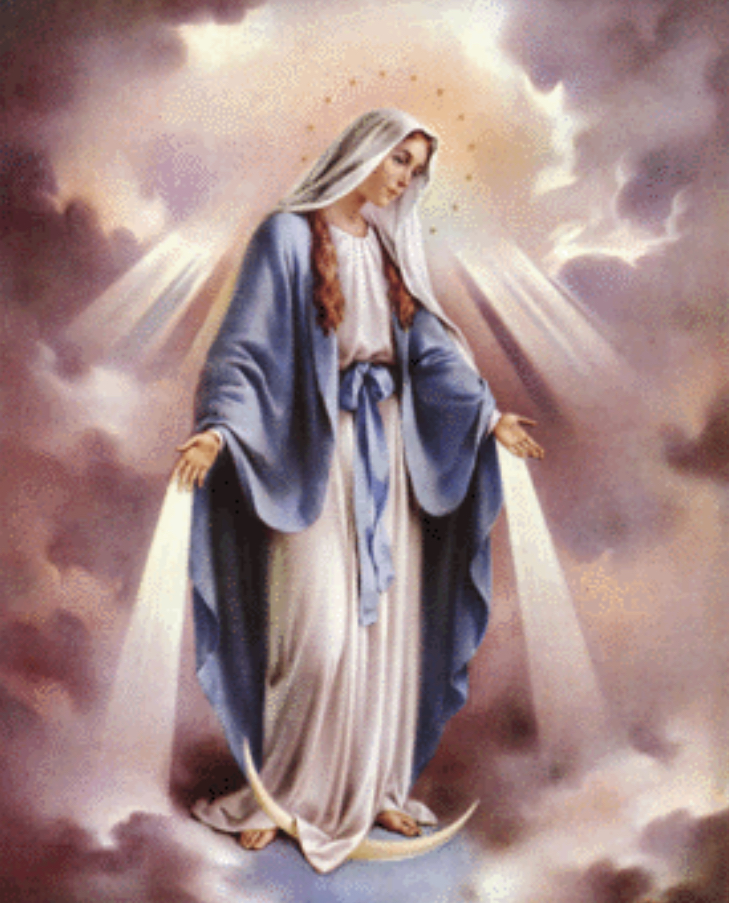
And Mary is also the embodiment of a certain perfection of the Church itself,
"But while in the most Blessed Virgin the Church has already reached that perfection whereby she exists without spot or wrinkle, the faithful still strive to conquer sin and increase in holiness. And so they turn their eyes to Mary", in her, the Church is already "all-holy." –CCC 829, Lumen Gentium 65; cf. Eph. 5:26-27
"In the meantime the Mother of Jesus, in the glory which she possesses in the body and soul in heaven, is the image and beginning of the Church as it is to be perfected in the world to come. Likewise she shines forth on earth, until the day of the Lord shall come, a sign of certain hope and comfort to the pilgrim People of God. –CCC 972, LG 68; cf. 2 Pet 3:10
Although there is not a tradition of a Popess in Christianity, there is a strong tradition of honoring Mary as Mother of God (Mater Dei), Queen of Heaven (Regina Coeli), Seat or Throne of Wisdom (Sedes Sapientiae), Ever Virgin (Semper Virginem), and Ark of the Covenant (Foederis Arca). Here she is depicted having a tiered crown bestowed on her head by Jesus, entitled "Coronation of the Virgin."


In this respect she shares many titles and symbolic tradition with these other goddesses (such as, Neith [virginally gave birth to the gods (parthenogenetic), Mother of Ra/Sun/God], Athena [Parthenos "virgin"], Artemis [virgin goddess], Isis [Seat / Throne, Mother of Horus], Hathor [House of Horus], who have been compared in concept with Wisdom / Sophia / Chokmah and The High Priestess here, although she herself is, by the Church, most emphatically, not called a goddess or given the title of goddess. But what is a goddess? That's something to think about.

What the Roman Catholic Church says of Mary is that she is the Immaculate Conception,
The Most Blessed Virgin Mary was, from the first moment of her conception, by a singular grace and privilege of almighty God and by virtue of the merits of Jesus Christ, Savior of the human race, preserved immune from all the stain of original sin. –Catechism of the Catholic Church 492: Pope Pius IX, Ineffabilis Deus(Dec. 8, 1854)
Also, that,
"By the grace of God Mary remained free of every personal sin her whole life long" – CCC 493
So Mary was conceived without sin (in herself), and this has nothing to do with how she was conceived, i.e., it is not speaking to the fact that she was conceived in the usual way, through the (non sinful) sexual intercourse of her parents (they were legit married). Jesus however, is said to be God (the third person of the trinity), therefore the fact that he was conceived in his bodily form as sinless would be a given. And Jesus was not conceived through sexual intercourse, as was Mary. Jesus is said to be "conceived by the Holy Spirit," indicating that he is wholly the son on God and not begotten by a human father.
The angel answered, "The Holy Spirt will come upon you, and the power of the Most High will overshadow you. So the holy one to be born will be called the Son of God. Luke 1:35
However, we as children of God are meant to partake in his divine nature.
Now the Father's will is to "raise up men to share in his own divine life." (LG 2.) He does this by gathering men around his Son Jesus Christ... –CCC 541
Baptism not only purifies from all sins, but also makes the neophyte "a new creature," an adopted son of God, who has become a "partaker in the divine nature," member of Christ and co-heir with him, and a temple of the Holy Spirit. –CCC1265
And Jesus says, speaking of God the father,
I have given them glory that you gave me, that they may be one as we are one—I in them and you in me—so that they may be brought to complete unity. Then the world will know that you sent me and and have loved them even as you have loved me. John 17:22-23
All Christ's riches "are for every individual and are everybody's property."(JPII, RH 11.) –CCC 519
Christ enables us to live in him all that he himself lived, and he lives it in us. "By his incarnation, he, the Son of God, has in a certain way united himself with each man." (GS22,2.) We are called only to become one with him, for he enables us in his flesh as a model: –CCC 521
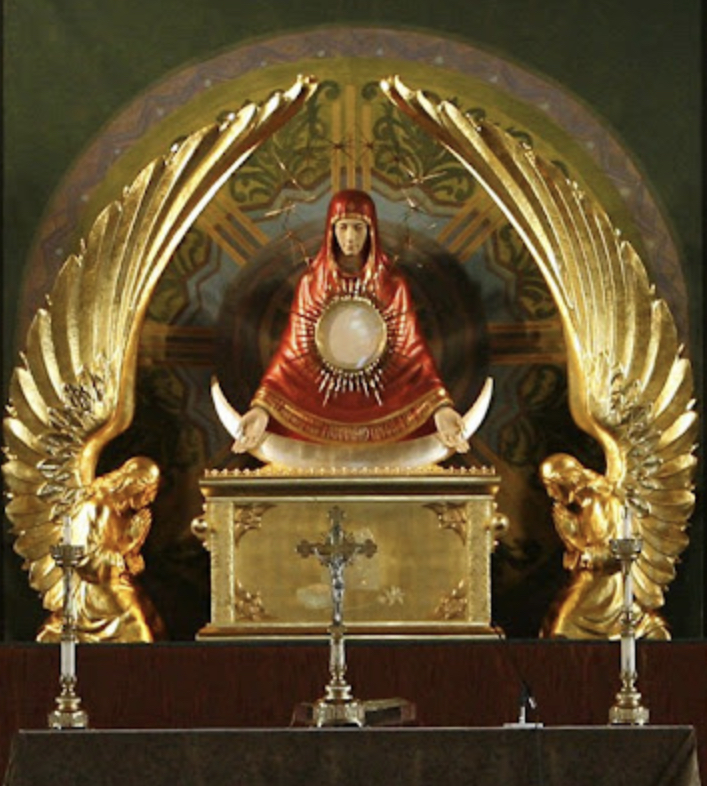
... therefore be shrewd as serpents, and innocent as doves. Matt 10:16


