Saturday, May 10, 2014

You're My Everything

   eXtreme Deep Field, 10 yrs. of NASA Hubble Spactelescope photographs from a patch of sky at the center of the origional Hubble Ultra Deep Field(an area about 1/10 the angular diameter of the moon as viewed from Earth), released Sept. 25, 2012 

Our visible universe is a sphere with a diameter of approximately 92 billion light years. Just that part, what is visible, is awesomely huge. Because of the enormity of this space it is easy to snuggle down in the middle and not have to think about the nature of the reality we are a part of. Regardless of how unfathomably gigantic the universe is, the question remains, "What is just beyond the edge of the universe? What happens at the end?"

   Truman Show, 1998, Truman at the Edge of his World

Wouldn't there have to be a boundary? How could it be possible for the physical universe to be infinite? Is there a wall there? Is the universe an enormous dome? an egg? or a torus? What if you got to the edge and you found a stairway that led to a door? What would be on the other side of that door? It is easy to get caught up in the distractions of everyday life and not conscider the ultimate questions. Contemplating the boundaries of space is like contemplating death. Someday you will die, but it's not now… it is in the enigmatic future. Someday you will reach the edge of the universe as well, if you travel there in your mind, and you will have to walk up those stairs and see what is on the other side of that door… and there is no turning back.

     Flammarion Wood Engraving, artist unknown, first published 1888

Universal is from Latin universalis "of or belonging to all," from universus "all together, whole, entire." The noun usage universum "all things, everybody, all people, the whole world" is where we get the word universe, it is from unus "one" + versum "turned", said to be, literally "turned into one."  This explanation, however, is a bit perplexing. We say that the universe is everything there is. It is all space and matter(at least on this plane of reality) existing as a whole. And the sense of being universal is to be one. So where does this notion of turning fit into the word? In other words why did the Latin universum come to mean "all things, everybody, all people, the whole world" in the first place? Why not just uni-totum "all one" or something like that?

We might think universe to be more like one + verse, "verse" as in, "writing arranged in a a rhythmic pattern." The Word was spoken and the universe came into being along with its order and laws of nature. Not only does versus in Latin have the meaning of "turn toward or against," a form of vertere "to turn, turn back, be turned, convert, transform, translate, be changed", from PIE *wer-(2) "to turn, bend," versus also has the meaning of "a turn of the plow, a line, row, line of verse" as a noun. So couldn't we say the universe is the one verse? Maybe the hymn of the creator? But what does this "verse" have to do with turning either? A verse is a row of poetry, like a plowed line in a field. The soil is turned and it is then ready to take seed and produce growth. The thing about verse is that it seeks to produce more than what is simply written down. It is meant to be fertile ground for the reader or hearer of the poetry to grow the fruit of emotion and experience which the writer of the verse hopes to share.


    A Child's Garden of Verses, by Robert Louis Stevenson 1969 edition

When I was sick and lay a-bed,
I had two pillows at my head,
And all my toys beside me lay,
To keep me happy all the day.

And sometimes for an hour or so
I watched my leaden soldiers go,
With different uniforms and drills,
Among the bed-clothes, through the hills;

And sometimes sent my ships in fleets
All up and down among the sheets;
Or brought my trees and houses out,
And planted cities all about.

I was the giant great and still
That sits upon the pillow-hill,
And sees before him, dale and plain,
The pleasant land of counterpane.


This word "verse" is connected to words for growth, as in, anniversary which has the meaning of an annual return, the literal spinning/turning of a cycle, and birthdays(a year of growth). Vertex and vertical are from vertere as well. Produce is grown in rows(verses), their growth is often vertical and they are green, or vert / verte in French. Vert is Old French "foliage, greenery," from Latin viridis. Spring, the time of spiraling growth, begins at the time of the vernal equinox. So the turning has to do with cycles and growth. But what of the meaning "versus", as in us vs. them? And the word advert "turn away"? In Latin versus has the meaning of "turn toward or against." 

When the ground is turned isn't it a violence to the ground? However, this adversity is what makes it fertile. Turning is change and change can be perceived as good or bad, i.e. as a growth upward like a plant, or an encounter with a foe which can create heroes, or victors in a match. Often it is the opponent who motivates a person to grow their talents and get better.

    David and Goliath, Edgar Degas, c. 1863, Fitzwilliam Museum, University of Cambridge, UK

This brings us back to the "turned"(versum) in universe. What was the ancient notion of this one(unum) thing which they saw as the dome of the night sky? Everything in the heavens appeared as if it were revolving around them. 

Turning has the sense of creating, as in the turning of clay upon the potters wheel to make a pot(which is green until it is fired). Pushing against the clay, i.e., hand vs. clay, on the lathe causes the growth of the pot. Maybe the universe was thought to be one thing, as in one fashioned thing, like a pot that is turned on a wheel. When the clay is being turned(being formed on a wheel) and thus turned into a pot, it grows up vertically and out with the motion. Maybe the universe is "one  turned" in this sense, it is one vessel or pot, we might say a uni-vas/vassa "container, vessel".

The Uni-vase 


Here is a depiction of the ancient Egyptian gods(neteru) Isis, Nut and Nun from the Valley of the Kings. Above the heads of the gods are their hieroglyphic representations / names. 

    Isis, Nut, and Nun from the House of Eternity, Valley of the Kings, reign of Seti I- Ramses II, 1290-1213 BC

The first on the crown of Isis(iSt) is st  meaning "seat, throne, place, abode, tomb, room." On the head of Nut is a nu "pot" with t "bread loaf"(feminine gender indication) and the platform indicating pt "sky". So Nut is nu + t + pt(not pronounced in her name), nevertheless this would make her Nut, Pot (of the sky) visually, and she is in fact the womb or vessel(pot) from which Ra, the sun, was reborn each morning from the platform of the pt "sky." The last figure is Nun/Nu, his hieroglyph is three nu's "pots" on a pt. The tripling is meant to indicate many, and nu was "pot", as in, a container of the waters. His name sometimes has the hieroglyph for "waters" with it as well which is also made of a triplet of three horizontal wavy lines(the wavy line "water" indicating the letter "N" in hieroglyphs as well). 

"Nun" = nu nu nu + [ pt ] + n n n

So he is the many waters, Nu nu nu. Maybe even the big no no no, being too big to contemplate.

Nu / Nun was the ancient Egyptian god/concept of the primordial waters or abyss from which the first land appeared. Nun was what continued outside of the bounds of the created universe, but was also present in the water upon the Earth. Nun is sometimes depicted as a frog or a man with a frog head, as one of the Ogdoad ("the Eightfold" Gk.) of Khmun(Hermopolis), four male gods(depicted as frogs during the Late Kingdom) and four female gods(depicted as snakes), Nu and Nunet(the primordial waters), Amun and Amunet(air or invisibility, hidden one), Kek and Kekut(darkness [the primordial darkness/chaos, also related to transitions between light and dark, called "bringer-in-of-the-light"), and Ḥeḥ and Hehet(infinite space, infinity, eternity. These were the forces from which creation arose.

The sun rises from the mound of creation at the beginning of time. The central circle represents the mound, and the three orange circles are the sun(ra') at different stages of its rising. At the top is the "horizon" hieroglyph with the sun appearing atop it. At either side are the goddesses of the north(Neith?, right) and south(Anuket?, left), pouring out the waters that surround the mound. The eight stick figures are the gods of the Ogdoad, hoeing the soil(turning verses). - 21st Dynasty, c.1075-945 BC, from the Book of the Dead Khensumose 
In the beginning neteru created the heavens and the earth. Ḥeḥ was without form and void, and Kek was upon the face of Nun; Amun was moving over the face of Nun. 
And Seker cried out, "ḥ'r wr!(Horus the Great [Light])"; and there was the first great light of dawn. 
Genesis 1:1-3 [my own trans-concept translation] - the first day / revolution / turn
Turn is from Old English turnian "to rotate revolve," also Old French torner "turn away or around; transform, change; turn on a lathe, both from Latin tornare "polish, round, turn on a lathe," from tornus "lathe", Greek tornos "lathe". When certain matter is turned it is made into something through revolution and applied pressure. 

Nun was sometimes combined with the god Ptah whose name means "create", patron of craftsman, as Ptah-Nun, father of the sun god Atum Ra. In this passage, the heavens, i.e., the dome of the universe, is described as Ptah's potter's wheel, i.e., his turn(versus) table, or tornos.
The Potter's wheel is the wheel of the revolving heavens; and Ptah is addressed in a form which agrees very well with the idea that the perpetual gyration of the wheel generates all things: "O God, Architect of the World, thou art without mother, being born through repetition of thyself." -Creation Records Discovered in Egypt [Studies in the Book of the Dead], by George St. Clair, 1898, ch. VIII, pg. 116
The one-versum(turned), i.e., universe seems to be Nut, the one pot(nu) of water, or womb which turns about the heavens, the space of creation, from out of Nun, and it was believed that one day creation would return back to Nun, the watery chaos.

Back to none?

None is from Old English nan "not one, not any," from ne "not"+ an "one", analogous to Latin non "not, by no means, not at all, not a", from Old Latin noenum "not one".

So maybe we could call Nun, Mr. "no one", or Mr. Nobody. But Nobody is not necessarlily inconsequential, as the Cyclops, Polyphemus, can attest to.  

    Odysseus Blinding Polyphemus, Italian, early 16th century
Then in his turn from out the cave big Polyphemus answered: Friends, Nobody is murdering me by craft. Force there is none. But answering him in winged words they said: If nobody harms you when you are left alone, illness which comes from mighty Zeus you cannot fly. But make your prayer to your father, Lord Poseidon. Odyssey, Book 9, ln. 455
Odysseus, passing himself off as Nobody, put out the eye of the cyclops "circle-eyed" and escapes imprisonment in the cave with his remaining men. Put is from Old English related to pytan "put out, thrust out," from a Germanic stem(related to Old Norse pota "to poke"). Pytan "put out," is perhaps like Ptah-ing[like a potter]. When a potter creates a pot[a pota, a thing poked?] he does poke and push out the clay. Ptah is the potter or poker of the pt "sky".

Poseidon, the father of Polyphemus, is god of the sea, not unlike Nun, therefore, watery and enigmatic, a Mr. Nobody, known as "Earth-shaker". Poseidon is from Poseidaon/Poseidewanos in Mycenaean, and in Aeolic is Potaidaon, Doric Poteidon/Poteidaon/Poteidas, said to be perhaps from PIE *potis "husband, lord". The second element is debated as to whether or not it is related to the word for "earth" da in Doric, from of ge(meaning "earth" as in Gaia), or from Doric dawon "water", as in either "Husband/Lord of the Earth" or "Lord of the Water". This combination of earth and water is a bit like the combination of the two Egyptians gods Ptah and Nun. Perhaps there is a bit of truth in both. Ptah-Nun/Potaidaon the divine potter of the waters of the universe.
[This is also in concept like the Sumerian god called Enki "Lord of Earth" / in Akkadian called, Ea "House of Water," god of crafts, fresh water, seawater, wisdom. As opposed to the a Sumerian, Enlil "Lord of Wind"(like the Egyptian Amun), and the Sumerian, An "sky", like the Greek Uranus/Ouranus, personification of the sky.]


   Horses of Neptune, Walter Crane, 1893

Poseidon was also known as Poseidon Hippios, the god of horses. As a horse he pursued Demeter Δημήτηρ / Damater [Doric] Δαμάτηρ (possibly from da "earth"+ metēr "mother"). She turned herself into a mare and tried to conceal herself in a heard of horses, however, Poseidon turned into a stallion and raped her. Demeter bore Desponia ("Lady / Mistress of the House") and the swift immortal horse Arion.

Neptune is the Roman counterpart of Poseidon. Neptune is said to be probably from PIE *nebh- "cloud", related to Latin nebula "mist, vapor, fog, smoke," Greek nephele, nephos "cloud." Neptune was also associate with horses under the name of Neptunus Equester.


    Horsehead Nebula, DownUnder Observatory, Freemont, MI., by Terry Hankock

So Neptune is the nebh "cloud/mist of heaven"+ tune. The "tune" of the nebula forms stars and produces the music of the spheres. Tune is a variant of "tone", from Latin tonus "a sound, tone, acent", literally stretching, as in stretching, tightening, making a string taught, related to teinein "to stretch". When the right tuning occurs, solar systems and worlds are formed. So maybe it is not a stretch to connect this teinein with the Egyptian god Ta-tenen "risen land", the primordial mound, the rock(petros), that "streached" out of Nun. Ta-Tanen is combined with Ptah(Pee-tah/"Peter") in the Old Kingdom(c.2649-2150 BC) as Ptah-Tatenen. So if we substitute this Ptah "create" for tune, this would make Neptah out of Neptune. 

In Norse mythology the spring Hvergelmir "roaring kettle / bubbling boiling spring" is the source of the eleven rivers and was the origin of the causes of creation. 
This seems to be similar in concept to Nun(primordial waters of the universe). Its forces flowed south from Niflheim (from nifil "mist," cognate with Gk. nephele "cloud" + heim "home", similar to the abode of Neptune and Poseidon) to Ginnungagap "mighty gap" called the Yawning Void. Ginnungagap was the vast primordial void prior to the creation of the manifest universe. Ymir, the first proto-giant came to be from the interaction between the nebulous realm of primordial cold, ice, and fog to the North, Niflheim, and the realm of fire to the South, Muspellheim, in this mighty gap. 

Audhumla, the gigantic cow, uncovered the first man, Buri, in this void by licking the salty stones around Ginnungagap. Ymir was nourished by Audhumla, and in the Poetic Edda it states that the world was eventually made from the body of Ymir. 
From Ymer's flesh, in the dawning of time, was made
The earth, and from his blood the raging sea,
The rocks from his bones, and from his hair 
the trees, and plants; his skull became the vaulted heaven;
And Midgard, from his fringed lids, the gods
Kindly have fashioned for the sons of men;
And from his brain, the clouds that dress the sky
Of Summer, or dart their lightnings in the storm,
Their first substance had. - The Song of Grimner, C.P. 1851

    18th Century Icelandic Manuscript, Danish Royal Library- Adhumla licks the salty stones around Ginnungagap and Buri emerges.

Nut is also sometimes portrayed as a great cow of the sky, as well as in her other forms(a sycamore tree, starry sky lady, sow). Hathor was commonly portrayed in the form of a cow. Nut and Hathor personified the appearance of the Milky Way in ancient Egypt.  
She[Hathor] was originally a personification of the Milky Way, which was considered to be the milk that flowed from the udders of a heavenly cow (linking her with Nut, Bat and Mehet-Weret). Hathor, Ancient Egypt Online
Nut, Nwt means "[night]sky" and Hathor, ḥwt hr, "House of Horus"(the abode of the ḥr.w "sky"; "one who is above / Falcon" god, Horus). So they are similar aspects of the same archetype.

This gives some context to the term, galaxy, which is from Late Latin galaxias "Milky Way," from Greek galaxies kiklos "milky circle", from gala(galaktos genitive) "milk". 
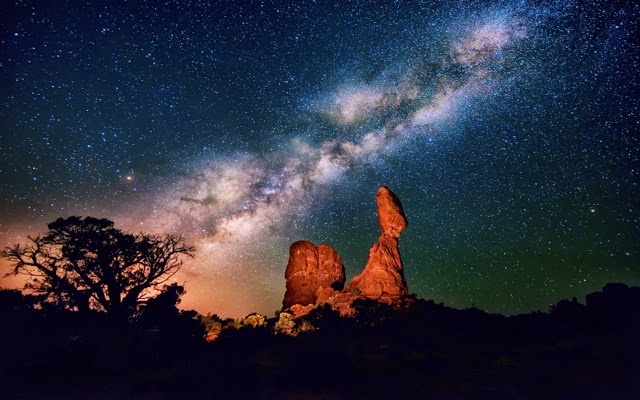


    The Milky Way, from The Center for Planetary Science, Photo from NGC.

Cosmos is the Latinized form of the Greek kosmos meaning "order, good order, orderly arrangement." Pythagoras was first to use it for "the universe." Kosmos does have a secondary meaning of "ornaments on a woman's dress, decoration" like the starry mantle of Nut perhaps. We might say someone is "put together," kosmos, when they dress in a fine clothes and have their hair done(kosmokomes "dressing the hair") and all is in good order and neat arrangement.

    Our Lady of Guadalupe looking stellar in her Cosmic Cloak, 1531

Kosmein had the meaning "to dispose, prepare", especially with the meaning of "order and arrange(troops for battle), to set (an army) in array". God is one who orders(kosmein) the Cosmos. They are not a random bunch of gasses and rocks strewn around the universe. 
Lift up your eyes on high and see: who created these? He who brings out their host(army) by number; calling them all by name; by the greatness of his might, and because he is strong in power not one is missing. Isaiah 40:26
Why would one be "missing" unless they were in a particular order for a particular purpose? And why would the stars be named unless they had a particular purpose and nature?

The saying, "You look stellar," takes on new meaning. The universe is cosmic. Like the most intricate amazing arrangement to produce life and variety while still being ordered to a good end.


    A Cosmic Looking Image of a Border Feature Inside the Mandelbrot Set, by Binette228, Wikimedia

We imagine that here on Earth we stand on solid ground and the great oceans are supported by the land. And so it is the case in a sense. But actually our precious Earth is just a giant starship in the fathomless ocean of space. The vastness of space, time and existence can be scary to contemplate. We might feel as if we will get lost or swallowed up. However, we can take comfort in the fact that no matter how far we travel either in or out, the cosmos is well ordered and we will be at home in it. Let's not be afraid to explore. Engage!


You're Everything.


Tuesday, April 29, 2014

Stuck in the Middle With You


    Castle and Sun, Paul Klee, 1928, Oil on Canvas

This painting is very interesting considering how seemingly simple it is. It reminds me of children's play building blocks. Sometimes simple things can be deceptively complex. When you consider that the artist started out with a blank canvass . . .  then he created this . . .  and darn it, it looks good! It has to do with his color choices, and sense of proportion, and placement. Try to imagine yourself sitting in the same place. What medium do you use? Which brush? What's your technique? What's your vision? What would you come up with? Would it be as interesting? Intriguing?

Intrigue in its original sense meaning "to trick, deceive, cheat," is from French intriguer, from Italian intrigare "to plot meddle; perplex, puzzle," from Latin intricare meaning "entangle, perplex, embarrass." When something is intricate (a form taken directly from Latin intricatus "entangle," from  in "in" + tricae "perplexities, hinderances, toys, tricks"), it creates interest, from Latin interesse "to concern, make a difference, be of importance," from inter "between"+ esse "to be." You have to look closer and get in it to see the detail, or solve the mystery. It spikes curiosity and makes us care. Maybe there is a puzzle or game to solve. Interest is the opposite of boredom.

    Sherlock is Bored!- Sherlock, The Great Game, Episode 1.3

God is Omnipresent, which is to be ever everywhere, from omni "all" praesense "present",  pre "before" esse/essent "to be".  God is Presence. Essence. I AM. This can be an interesting puzzle to contemplate. Exactly who and what is God? Traveling toward extremes can be exciting and interesting, however, this same endeavor can also end up leading to the opposite, i.e., boredom, ennui, or ruin, such as when the investigative genius, like Sherlock, hits a dry spell, or thinks they have solved all the mysteries. 

It is interesting, then, that God is an extreme character. Nothing is more extreme than being the Esse, the All, the One. But is God, then, alone (from all "all"+ an "one")? That would be a whole lot of alone. That is a big and fearful void in our eyes, too big, and too small, a vast abyss. Like when you think about the edge of the universe, what is just beyond it? And what is smaller than the smallest particle? … More. Infinity. Eternity. It cannot even be spoken. 


Fortunately that's none of my business. 
O Lord, my heart is not lifted up; my eyes are not raised too high; I do not occupy myself with things too great and too marvelous for me. But I have calmed and quieted my soul, like a *weaned child with its mother; like a weaned child is my soul. Psalm 131:1-2 [*in the sense of: a child who doesn't cry for milk, who has dealt with the struggle of being weaned.]
So yes, one can go too far thinking about eternity and the eternal, but really the problem comes down to a fearful simplicity, or the prospect of an eternal boredom, getting stuck in an endless monotony (from Latin monos "single, alone"+ tone) where nothing interesting happens, everything is seen, there is no complexity or mystery. That is just hellish. 

But where is the place of of interest if you can't find it by striving, and it is not at the extremes?

   The Little Prince, Antoine de Saint-Exupéry
"Be my friends, I am all alone," he said.  
"I am all alone--all alone--all alone," answered the echo. 
"What a queer planet!" he thought. "It is altogether dry, and altogether, pointed, and altogether harsh, and forbidding. And the people have no imagination. They repeat whatever you say to them… On my planet I had a flower, she always was the first to speak…" -ch. 19
The extremes turn out to be lonely places. The mean is usually more comfortable. Not too high, not too low, not too big not too small, not too dry, not too wet . . .  just right.

Like Goldilocks.

    Goldilocks and the Three Bears

That golden spot is somewhere in-between, in the middle, at the heart of, or at the center. Maybe that's where the eyes naturally go, or you might say the place of interest to the eyes.
Center ring at a circus is the place of greatest interest. Center podium is gold, the first place winner.

Interest is what is inter + esse "be between, among, in the midst of," like the inner tree in the garden (gan "enclosure, garden" in Hebrew, from ganan "to cover, surround, defend") enclosure of Eden. It was the forbidden tree of knowledge . . .  and that is partly what made it so interesting.
but God said, "You shall not eat of the fruit of the tree which is in the midst [betawk(tavek)] of the garden, neither shall you touch it, lest you die." Genesis 3:3
In Hebrew tavek is "midst, between, inside, within, middle, among, home." The tree was in-between (inter + esse) the garden. Interesting.

    Golden Rectangle with Continuing Pattern, Golden Ratio / Mean / Section, φ = 1.61803398875...

It is also interesting that when the golden rectangle (which is an enclosed space, like a garden), which is made using the golden mean, is bisected diagonally, and the next smaller golden rectangle is likewise bisected, where they meet forms an intersection at the center, or in the midst, of an infinite spiral. Phi φ is not a rational number . . . it is magical. 

The X marks a spot, i.e., the place in the midst of the enclosure. The golden ratio is the proportion often found in nature that we find so pleasing. 

    Shell Exhibiting the Golden Spiral, Growth Factor is Phi, it is a home for an animal

The mathematical structure of nature can be intriguing and intricate. It can create organic serpentine shapes, or vast veinous labyrinths to confuse, or entertain the eye, which is pleasing, not boring, robotic or predictable. Amazing, good trick!

     a+b is to a as a is to b, Golden Ratio in the Insect World, knowhowledge.com

Not only does phi φ create interest, it allows for organic movement, flow and structural stability / balance, and that is also beautiful. However, phi is also a little dangerous, which can be interesting too. It is the divine proportion used in creation. Knowledge of the divine is in creation, the knowledge of the good / beautiful and, finally, also the knowledge of chaos / evil that must be tamed and conquered.

    Vitruvian Man, Leonardo da Vinci, c. 1490 - made in the image and likeness of God.

In ancient Egypt the concept of balance and harmony was known as ma'at / maat / mat / mayet. Ma'at is usually translated as "truth" or "that which is straight," with the idea of order, balance, and justice. It was against the feather of Ma'at that the deceased's heart was balanced during the Weighing of the Heart Ceremony in the Duat (underworld). After the ceremony, what ensued in the after-ma'at, or after the math (weighing), was either the admittance into paradise [a safe enclosure], or Ammit, i.e., the "devourer," "soul-eater" and destruction; the second death. 

    Weighing of the Heart, from The Book of the Dead, (to the right)Anubis with Feather of Ma'at in Balance, Thoth Recording, Ammit Waiting.

Ma'at was also the "mat" or stone platform / foundation, that the gods (neteru) stood upon in artwork and statuaries which was an indication of their authority. 


    Ma'at, and Hawthor seated on a foundation "ma'at"[reproduction], Tomb of Nefertari, Valley of the Queens, 19th dynasty, 1270 BC

Ma'at was the primordial foundation of stability, balance, justice, order and truth, and the foundation of the universe. In the earliest representations a raised platform / plinth was her symbol, latter she came to be represented by the ostrich feather.


    One Rendering of Ma'at in hieroglyphic Form- Platform/Foundation ma', Sickle (cut with sickle) ma, Arm (cubit measure) meh + Semicircle (bread, loaf) t ending used to indicate feminine gender + Seated Goddess with Feather of Truth (determinative)

Ma'at was considered to be the counterpart of isfet "injustice, violence, chaos". We might say Isfet is a fit, or was a worthy or fitting (from [perhaps] Middle English fit "an adversary of equal power" related to Old English fitt "conflict, struggle") opponent for Ma'at, personified as the serpent Apep (Apophis, Gk.) "Lord of Chaos" during the Middle Kingdom.

    Apep/Apepi/Aapep or Apophis(Gk), Personification of Isfet, from 21st dynasty Book of the Dead, Egyptian Museum, Cairo

The two opposite forces balanced each other. Like a hero and nemesis / archenemy / antagonist. There is never a hero without a struggle to overcome. In a certain way the hero is born from the nemesis, as truth / light is born out of chaos / darkness. But the creation of the hero is the destruction of the nemesis, as the creation of order and balance is the destruction of chaos. However evil is never entirely annihilated, although maybe eliminated (from ex "off, out" + limine "threshold." Evil is kicked out, put in its place . . . hell.

Ma'at offered a stable foundation on which to build a home in the surrounding chaos. A secure place of rest . . . but what really is it? Think about what the feather represents. Ma'at is lightness, as a feather that blows in the wind.
The wind blows where it wills, and you hear the sound of it, but you do not know where it comes from or where it goes; so it is with everyone who is born of the Spirit. John 3:8
The truth, the "firm" foundation of everything, is really not a solid thing, it is rather an idea or a state of being, a finesse,  from French finesse "fineness, subtlety," from Old French fin "subtle, delicate; perfected, highest quality," or maybe we could say, an achievement of the  fin "end, conclusion" of esse "being" (as in the aim, purpose, target); a certain purity (which when found within will be manifested externally as well).
The kingdom of God is not coming with signs to be observed, nor will they say, "Behold, here it is!" or "There!" for behold, the kingdom of God is in your midst / within you (entos "within, inside"). Luke 17:20-21
The solidity around us that we know as matter, and reality is really a lot of empty space. Think of atoms or the smallest of small most simple particles. What are they? Is there not yet another universe inside of them? It's tricky. How can they make this solid world around us that we believe to be so sure, that we perceive with our senses? We think we are really touching, seeing and hearing what is there, but it is actually just an interpretation of energy by the organ of our brains. Regardless of of exactly how un-solid reality actually is, still we are standing here made out of it. So for all practical intents and purposes we can say we do touch, see and hear what is actually outside of us. This is a balanced perspective. We don't need to deny the reality of reality, but neither should we deny the nature of reality… even if it is not entirely comfortable. 

Bodies tend toward entropy, yet the foundational building blocks remain.


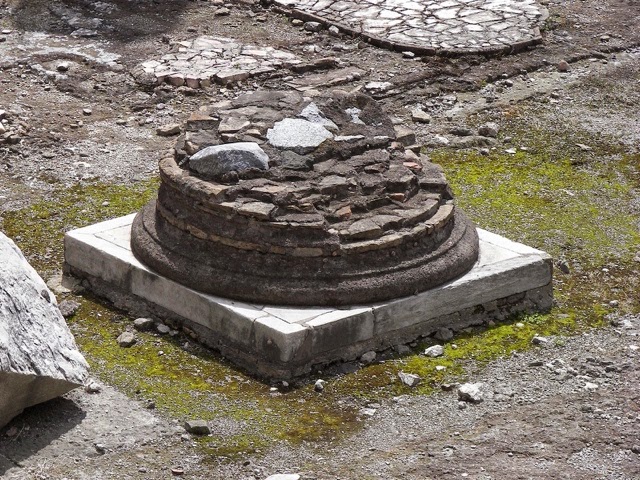
    Column Base in Trajan's Forum, Rome, 113 AD, the Column is Gone but its Foundation Remains. 

So, finally, it seems to be, that the apparently irrational, magical or unreal is actually the foundation for the rational, logical and real. 

People use tricks of design like phi to make the structures pleasing, or interesting to the eye as well as for the sake of stability. Columns witch support the structure have bases or foundations, as well as does the whole building which is built upon a foundation. 

The Parthenon in Greece is a classic building which displays the use of the golden ratio. Parthenon is from Greek parthenos "maiden, virgin".  

    Parthenon, Athens, Greece, 447 BC, Temple of the Virgin

Athena was the patron goddess of Athens. The Parthenon was a temple dedicated to this virgin goddess. Virgin is from Latin virginem (genitive virgo) "maiden, unwed girl, or woman," also used as an adjective meaning "fresh, unused," as in "virgin wool." Virginem is said to be related to virga "young / green shoot, twig, switch." However, we could say that a virgin is also a "free woman," rather than simply being an "unmarried" woman, or a woman who is has not had sexual relations. This idea of "being free" would draw in a connection with vir "man, hero" in Latin, from PIE root *wi-ro- "freeman, man," *uiHro- "freeman"). Perhaps even vir + gyne ("woman" Gk.), a "freeman" who is a "woman," or vir + genesis (Latin "generation, nativity", from Greek gignesthai "to be born, from PIE *gene-/*gen- "give birth, beget")," that is, a person, "created / born" a vir "man" (a human being) in the state of freedom (before or without being married). In the ancient  world a woman was her own man, in this sense, until she was married and became the property of her husband.
According to Greek myth, Cecrops [Κέκροψ], the first king of Athens, invented marriage as a punishment for women. Before marriage existed, said the myth, women were the political equals of men, but the institution of marriage imposed limits on their power. Ancient History & Civilization, Erenow.net
And it seems reasonable that the origin of vir as meaning "man" could also be related to virga as well [as virgin]. In that both virgins and freemen are people with potential or vitality like green (young) shoots, and "green" in Latin is viridis. The vir "man" being a "shoot of the earth / ground", or what sprouted or grew out of the mud, i.e., ha'adam  / man / mankind. 

This gives new meaning to the term "ever virgin." 

Not only can a woman be a "freeman" in an unmarried state / virgin, a woman can also be virago, a word meaning "man-like or heroic woman, of extraordinary stature, strength, courage," from Latin virago "female warrior, heroine, amazon," from vir "man." This seems to fit the image of Athena the virtuous virgin.

    Athena Giustiniani, Roman Copy of a Greek Statue of Pallas Athena late 5th to early 4th century B.C., Vatican Museums

Pallas Athena, the patron of Athens was goddess of wisdom, courage, inspiration, civilization, law and justice, just warfare, mathematics, strength, strategy, the arts, craft, and skill. 

Virtue also comes from Latin vir "man," from Latin virtutem "moral strength, high character, goodness; manliness; valor, bravery, courage (in war), excellence, worth," and can be said of all men (humans), both men (males) and women (females). Virtue is the mean between the vices of excess. It is a balance between the extremes, and freedom from or victory (from victor "conquerer") over vice (from vitium "defect, offense, blemish, imperfection"). Athena is sometimes shown holding the goddess Nike "victory" in the palm of her hand.

    Pallas Athena, Gustav Klimt, 1898, Historisches Museum der Stadt Wien, Vienna

Victory over vice is achieved through balance. When things are out of balance  compensation, or payment must be made in order to restore balance and restore a state of grace, from Latin gratia "favor, esteem, regard; pleasing quality, good will, gratitude". 

Interest (%) as in "a payment made on top of the value of something for its use, or because it was borrowed", is from interest (n.) as being "a legal claim or right; concern; benefit, advantage", ultimately from a form of the Latin interesse "to concern, make a difference, be of importance," from inter "between" + esse "to be." How is this kind of interest % "being between"?

To charge interest is for the advantage or benefit of the lender (interested party) and not necessarily just about just compensation. It does seem that it can be "just" to pay a certain fee for borrowing a persons goods, because they were without those goods for a time, and also, maybe needed to invest time and effort in the lending of their money or goods. But how much compensation is fair compensation? And is a person always put out because of the lending, or is it the case that sometimes the lending doesn't cost the lender any inconvenience? It seems to be the case that a person can take advantage of another person's bad luck for their own advantage.

Advantage, is from Latin ab "from"+ ante "before, in front of, against".

    "This is a very interesting situation!"- George Bailey, It's a Wonderful Life, 1946

Interest payments may benefit, as in "advantage, profit" a lender in a way that turns out to be anything but equitable, and is more like using another human being in an unbalanced or vicious way(or, as in the case above, for the benefit of a harmless prank).

That is why it is called usury (from Latin usura "payment for the use of money, interest", literally "a usage, use, enjoyment", from usus, from uti (utilize, utility). So usury is a usage fee, but it can also turn out to be a using of another's hard luck or disadvantage in an unjust manner. Just because a person is desperate and willing to agree to pay a really high percentage of interest does not make it right. They may have no other option (or they may even just be stupid, or undisciplined). However, to charge a small amount (usage charge) for business doesn't seem to be inequitable, and seems legitimate, balanced, and not to be unjust usury, or abuse, from ab "away" + uti "make use of, profit by, take advantage of, enjoy, apply, consume" of the person who is paying back the fee. 

    Death and the Miser,  Jan Provost, 1515-1521 

In Hebrew neshek is "interest, usury", from nashak "bite; lend upon usury".
You shall not lend upon interest to your brother, interest on money, interest on victuals, interest upon anything that is lent for interest. To a foreigner you may lend upon interest… Deut. 23:19-20
There are a lot of strange rules and regulations in the Pentateuch which seem harsh and outdated now. Why would it be fine to "bite" a foreigner? Perhaps it could be that the people first had to learn how it is right to treat a brother(someone whom you care about, and whom you see as being like you) before they could understand how it is right to treat anyone and everyone, since we are ALL brothers, ALL neighbors, and ALL God's children. There actually are not any "foreigners" and therefore no one should be "bitten" or taken advantage of.
Which of these three do you think proved to be a neighbor to the man who fell into the robbers' hands? And he said, "The one who showed compassion to him." Then Jesus said to him, "Go and do the same." Luke 10:36-37 NASB 
And still even before they could understand how it is not right to "bite" a brother, they themselves were "bitten". So they were able to understand the feeling. When YHWH provided for them in the desert with "the bread of angels" Psalm 78:25, at no cost, they proved themselves to be ungrateful by complaining, rebelling with unfaithful spirits against him. So YHWH decided to treat them like foreigners for a time, rather than his children, and exacted payment from them in the form of interest (neshek) by means of the seraph serpents who "bit (nashak) the people, so that many sons of Israel died."Numbers 21:6 

This bitting that is associated with snakes, being related to an "advantage" or "benefit" and therefore usury, may have come from the idea of a snakes who lie in wait for their prey. Perhaps people who are bit by snakes feel like they are also the prey of the snake, and that they've been "taken advantage" of by the sly snakes who hide under cover waiting for an opportunity to strike at the heel.


    Rattlesnake Jake, Rango, 2011

However the idea that a snake would do this to gain advantage for itself, other than to defend itself, would be personification. Snakes don't actually strike at people because they (snakes) are wicked and enjoy to see people (who are "foreigners" to snake-kind) pay.

It is interesting then that the golden haired boy in "The Little Prince" let himself be bit by a serpent in order to return home. In using his mortal body for "payment", the bite (nashak) of the snake, sent him home. But why was the snake an interested party? What did it benefit from the arrangement? What was its self-interest and gain? . . . Unless it ate him! Think about it, the narrator says his body was not there the next day. . . 🤔😵🤯

What was the interest of the snake in the garden of Eden for that matter? Do they [snakes] just take enjoyment in death? Is it a case of misery loves company? . . .  like, "Guess what?". . . "There is NO Santa Claus, na-na-na!"
"There-is-NO-sanc-tu-ary!"
"The Wizard is a man behind a curtain . . ."

    Sad Tigger - So you're sayin' there's no Santy Claus? Not even a teeny weeny little one?

Yeah, feel good now, snake?

No, it's hollow; a bottomless pit. Who wants an eternity of that? It doesn't make sense. But it makes sense as an analogy. The snake is an agent of change and change isn't always comfortable, it can be downright terrifying even, but change is sometimes necessary to bring about balance, moving away from the extremes. 

It's not good to remain in ignorance as eternal children, however, we don't want to then get to the other side, and see a "Dead End", or even worse a cliff at the edge of an endless abyss. That's scary. It is scary to be at the end and find that you're in a box, not a garden, but a prison. 


It is much nicer to settle down in the middle, with a whole infinite universe above you and a whole infinite universe below. No matter where you go; in or out, there is always more. So, basically, you are stuck in the middle, which is nice and interesting place to be. It is a home, a secure enclosure, a paradise. The windows can be shut to all the noise and chaos on the outside. Yet, the possibilities in-between are endless. So if you ever find yourself at a scary  place or dead end, keep in mind, it's not actually the end . . . mind simply makes More.