Modern pewter is a gray alloy [a metal made by combining two or more metallic elements] of 85-99% tin mixed with approximately 5-10% antimony, 2% copper, bismuth, and sometimes silver. Ancient pewter, however, was a combination of approximately 70% tin and 30% lead.
The word pewter is from Old French peautre, from Vulgar Latin peltrum, source of Spanish peltre, Italian peltro, being of unknown origin according to the online etymology dictionary [OE].

Coming from the Latin peltrum, however, it seems reasonable that "pewter" could be connected to the PIE ([reconstructed]Proto-Indo-European) root *pel-(1) "pale". Pewter is a pale (gray) color. It does not tarnish but it can get dull over time, and the word pale, itself, comes from PIE root *pel-(1) "pale".
Metals are, in fact, sometimes named for their appearance / color.
Silver for example is the "shining" or "white" metal. The abbreviation for silver is Ag, from Latin argentum, silver, silver work, silver money. Argentum is from PIE *arg- "to shine; white".
If it is true that pewter is named after being pale in color, then it is similar to silver being named after its white / shiny appearance.
The English word lead is from Old English lead "lead, leaden vessel", from the Proto-Germanic *lauda- "lead," the origin of which is not agreed upon.
However, one hypothesis is that it is borrowed from Proto-Celtic *øloud-io- ('lead'), which, if so, is related to the Latin plumbum. And, *øloud-io- is thought to be the origin of the Proto-Germanic *bliwa- (also meaning) "lead," which stemmed the German Blei "lead," which is further interesting given that the German word for the color blue is similar Blau "blue." And lead is sometimes described as a bluish metal.

The English adjective blue,
So it seems possible that the name for the metal lead could be connected to its pale appearance, especially given that in other languages lead seems also to also be named after its appearance.
In biblical Hebrew, for example, lead is ophereth, from from aphar "dry earth, dust; ashes, dirt, earth, rubble, plaster, ground, mortar". So, might lead be named from its dusty or ashen (pale gray) color? Or if not, perhaps it is named for one of its states / appearances during the ore refining process, namely, a powder or paste.

Lead - Pb - Plumbum Nigrum / Black Lead
Ancient pewter was made from tin and lead, and the two, both tin and lead, were both called the same, plumbum, by the Romans. The Romans called lead plumbum nigrum, i.e., black lead, and tin was called plumbum candidum / album, i.e. white lead. In this case the meaning of lead as "pale", i.e. gray, gray-blue" makes sense; there is the dark gray " black lead," and the light gray "white lead," but only one of these we now call lead in English.
Historically metals were not always properly understood and identified, which lead to some confusion about the naming of metals. Lead itself is bright (white) like tin when cut but tarnishes quickly, and it is often found mixed with other metals and then separated from these lead-bearing ores, such as from Galena, which is an important source of silver. The original usage of the Latin word for "tin," stannum, actually referred to a mixture of silver and lead rather than tin.

And of course graphite (another "pale" substance, which is actually not a metal, but a form of carbon) was mistaken as being a form of black lead and called plumbago, derived from plumbum (lead). It is because of this confusion that modern graphite pencils are called "lead" pencils, when they do not contain lead.
Pewter is similar in its color to both tin and lead. Below are some examples of pewter, lead, and tin paint samples. There are many more tints/shades named after each metal, however, they are all just varying shades of gray.

The name of these metals are sometimes used as adjectives and are synonyms for gray, as with the paint colors, when they are referring to varying shades of gray. These colors are not made out of pewter, lead, or tin but just resemble the look of the metals. So, a person could say, "The wall is pewter," and mean that it is gray, and not mean it is made out of the metal pewter.
In Greek pelios is "livid (dark bluish gray [i.e., leaden] in color), dark," and polios is "gray"(as in of hair, wolves, waves), from PIE *pel- (1). So here again we see this root [*pel-(1)] sometimes related to the appearance of gray things and lead. It is also related to the appearance(color) of animals such as wolves and pigeons. Pigeon in fact, in Greek is peleia, pigeons being shades of gray, not unlike pewter.

Wolf Gray Textile
Pewter can also be related to another meaning of the PIE root (*pel-), namely, *pel- (3) "hide, skin." Wolves often have a pale or gray coat / pelt of varying shades, from white to dark gray, which could be said to be their "skin"(and their appearance). Pelt is a "skin of a fur-bearing animal," from *pel- (3) "hide, skin". Many types of pelts (from*pel-[3]) of animals are pale (from*pel-[1]) in color. The pelts of wolves are pale polios (gray), and even sometimes more pelios (dark or livid).

In Canto I of Dante's Inferno (begun c. 1308, completed in 1320) there is a description of three beasts guarding the way to the "shining Mount of Joy". The third beast is a She-Wolf,

Next we are told of the hound who will come and hunt down this wolf. The Italian text is,
In this English translation below, the Italian peltro is translated literally in order to keep in the style of Dante's rhyme, i.e., terza rema, "third rhyme". In English "pewter" does not rhyme with Fletro, as peltro does with feltro in Italian, so the word order is changed to rhyme "ground" with "abound" instead.
In some English translations license it taken with the rendering of peltro / pewter, as perhaps was the intent of the original. In this translation from Henry Wadsworth Longfellow, peltro/pewter is translated as "pelf", pelf meaning "money, especially when gained in a dishonest or dishonorable way".
Earth, ground and land are all meanings of the Italian terra. This last translation of "lands and loot" seems to steer the meaning of what the hound shuns in favor of more honorable or spiritual fare, toward the sense of acquisitions and power, such as gained by conquering. So, "loot and lands" as fare, seem to points to a vice such as avarice specifically.

It could be assumed that the word "pelf" and "loot" are used in the place of "pewter" because of the fact that money is made from metals, and pewter is a metal. So the assumption would be that Dante used the word peltro loosely to mean pelf/loot just because it rhymes with feltro, and not necessarily because it was the most appropriate word to use.
As far as I know, the word peltro is not commonly meant to mean pelf or loot. And, the word pewter in English itself is not a common way to refer to money/coinage, even if the name of other metals are used in this way.
A common coin used during the Middle Ages was a small silver penny (pfennig) or denarius. Other metals in use for coinage during the Middle Ages were gold and copper.

I'n not certain that pewter specifically was used for any coinage in the early 1300's, when the Inferno was written. Pewter is not commonly used to make money. There is an instance of pewter, copper, and brass coins, known as "gun money" being made by the forces of James II during the Williamite war in Ireland between 1689 and 1691. However they were designed to be redeemed for silver after the end of the war.
Silver can be used as a word to mean "money", as in silver coin, a person can be paid in silver(coin). However, the question is whether peltro (pewter) was meant to be used in this way to mean "money".
According to the etymology dictionary pelf (n.) is from mid-14c., "stolen goods," from Anglo-French pelf, Old French pelfre "booty, spoils"(11c.), of unknown origin. Its meaning as "money, riches," with pejorative overtone first recorded c. 1500. So it would be a more modern interpretation of the word "pelf" to mean "money" particularly rather than the more general "loot"(which is valuables as well as money). And it may not be the case that the word pelf evolved from some connection with the metal peltro (pewter) just because they both begin with -pel, even if this seems compelling, and a reason to use the word "pelf" specifically.
The origin of pelf is said to be unknown, but is suggested as being possibly related to pilfer. In that case, if true, pelf would originate from the root *pil- rather than *pel-. And this his makes sense when looking at the connection of the meaning of pelf to the definition of other "pil-" words such as pilfer and pillage. Pilfer(v.), for example, from 1540s, is from the Old French pelfre(n.) "spoils, boody" as well. Both "pelf" and "pilfer", being from pelfre, are said to be of unknown origin.
However pillage, from late 14 c., which is similar in meaning to pilfer, is from Old French pilage "to plunder, loot, ill-treat, is possibly from Vulgar Latin *pilliare "to plunder," said to be probably from a figurative use of Latin pilare "to strip of hair." So if pillage is connected to the Latin word pilus (plural pili) "hair," we might connect pillage to the notion of pile "things heaped up", or "a mound," this idea coming from what is commonly done to pili "hair." Pili is piled on top of the head. And also, sadly, pili (the hair), with the scalp attached can be pillaged from a person's head.

Smaug (and his loot). Illustration by Livia Ruzz for the 1975 Romanian edition, The Hobbit
The point of this whole consideration being that word pelf would not be etymologically connected to the Italian word peltro (pewter). And then, therefore, if this word, pelf, was chosen to translate the word peltro, it would have to do with the fact that pewter is a metal of value [it did in fact have high value during the Middle Ages], which might be considered "loot." But this loot, i.e., pewter (if meant to mean loot), would 1.) not necessarily have the connotation of "money" as such, rather just the notion of being of value. And 2.) peltro/pewter would not etymologically be related to the word pelf "loot." Pelf would rather have to do with piles of pilfered goods.
It seems like the sense of pewter, if used to mean pewter "the metal," was not referring to pewter coins, necessarily, but rather as a synonym for articles of value (probably stolen), as in, loot. So the question would be, was the word peltro, as in "the metal" pewter, used in the 14 c./ or meant to be used in this case by Dante, as a synonym for loot? Furthermore, is the translation of "earth and pelf,"or "lands and loot" [being things which are presumably figuratively eaten], a meaningful/fitting juxtaposition to "wisdom, love and virtue (virtute)"? Is loot/spoils/pelf something that is figuratively said to be fed upon? And was the word peltro meant to mean something of great value, or was it actually the opposite, meaning something base or common?
Before answering that question further. I'd like to entertain a different possible hypothesis.
Might the word peltro possibly be calling to mind something pale or gray ("pewter" adj.) and maybe earthy, or not of particular excellence? The gray is mundane, it's not exciting like the colors of a rainbow. It's not that there is anything wrong with earth, or gray, but they aren't particularly thrilling or elevated fare either. So rather than being vicious, they are, rather, just base. Gray is unexciting. And the earth/ground is itself literally base, being the thing we stand on below the heavens. Creatures are made from the earth and that is meant to be humbling.

Yet, it came to pass that the adam (pl.) would be cast out of the garden from whence they came.

"Migrant agricultural workers", Dorothea Lang, Nipomo, California, March 1936
Remember aphar in Hebrew is "dry earth, dust; ashes, dirt, earth, rubble, plaster, ground, mortar," and the word ophereth "lead" comes from this. Lead, which is another gray metal is a component of ancient pewter.
If you are what you eat, then eating earth points to being made of, or being of, the earth, and having earthly concerns and thoughts, and maybe not caring to endeavor to rise above this base nature, unlike the person who feeds off of wisdom, love and virtue.

Even eating what is grown or produced out of the earth, let alone dirt, such as, wheat/bread is still base to a certain extent because it feeds the body. Jesus talks of having food (and therefore eating of it) which is more spiritual in nature.
And again, as Jesus said to the tempter in the desert,

This meaning of peltro, as being something gray and of the earth, would seem to fit with the sense of the rendering of "terra né peltro" in a translation by Robert Pensky. He combines terra (earth) and peltro (pewter) into the single concept of "earthly fare." Earthly fare alludes to that which is common or base, as opposed what is virtuous and worthy. And thus it carries a negative connotation, as with the serpent in Genesis who was cursed to eat, or feed off of dust.

So, is the hound possibly feeding off of wisdom, love and virtue as opposed to this earthly fare? Perhaps not feading off of earth (adamah) or dust (aphar), as an allusion to the creation story?
Intriguingly, it is not even a completely outlandish to say that an animal would eat earth and dust. In fact, some animals do eat dirt, even clay specifically. This practice is called geophagia (earth + eat). Geophagia was first described by Galen, the Greek philosopher / physician in the second century AD. He recorded how certain sick or injured animals ingest clay. It is a practice found in the human animal population as well.

Gray / Pewter(colored) Clay
Argil is clay, and especially a white clay used by potters.
Argilla is "clay, argil" in Italian, which comes from the same root as argento "silver", and argent, i.e. *arg-. So in this case clay (argil) and a metal (argent/silver) are named from the same word. Clay can have a silvery color as well as, or like, the metal silver.

Clay can also be named or described by its pale appearance, as some metals are.
It is interesting that a word for clay in Greek is pélos "clay, mud, slime, pug" in Greek. Does this have to do with the fact that it is sometimes pelios (livid; dark) or polios (gray)? This word is used in this passage from the Gospels when Jesus makes clay to use in a healing of a blind man.

So the man was humble to have this mud spread on his eyes, and had to act in faith to go and wash in the Pool of Siloam instead of telling Jesus, "no thanks," and not submitting to this weird procedure that had no assurance of working. How many people are "blind" but will not be humble and submit to wisdom, love, and virtue in order to be healed of their blindness? . . . Not accepting that they are dust. . . YET that they are worthy of being raised above their earthy nature?
It is fascinating that under this hypothesis, i.e., peltrum referring to clay or dust, that a Hebrew word for "clay" is tin (phonetic teen), also meaning "common." NAS Concordance says this is from (Aramaic) perhaps corresponding to tit "mud, mire, clay." So here a word which in English means the metal tin, in Hebrew, a similar sounding word means "clay." And clay can be tin, lead, or pewter colored. So literally clay(n.) is tin(adj.), and tin is "clay". Furthermore, pewter is similar in color to plumbum (lead and tin), so pewter(n.) is tin(adj.), and tin(n.) is pewter(adj.) as well. Therefore in this sense we can say clay is pewter.
Tin, also, somehow inherited in its name the idea of something less pure than it actually is. Tin is an element designated Sn, from Latin stannum, and is not an alloy of various metals. However, before the sixth century stannum referred to a mixture of silver and lead rather than tin.
Tin is something that needs to be extracted, generally, from ore. A chief source of tin is cassiterite. Tin is extracted by a process that involves smelting (which is extracting [metal] from its ore by a process involving heating and melting).

Smelting ore
Tin is a very soft metal, but is an important element when used in combination with other metals, such as copper in the making of Phosphor Bronze (an alloy), which is actually stronger and less corrosive than copper alone. An alloy is "a metal made by combining two or more metallic elements, especially to give greater strength or resistance to corrosion." So, perhaps it is because of this process that tin is related to stannum.
Kassíteros in Greek is "tin," but also the adjective "pewter", the name having to do with a region where tin is mined, rather than a name deriving from its appearance. Pewter(n.) is kráma kassíterou, from kráma (alloy) + kassíteros (tin) is pewter(n.). So pewter is "alloy of tin" in Greek. Given these things, there is some argument for saying pewter, as an alloy of tin, carries with it some of the same etymological baggage as tin does, such as "dross." Not to say that tin or pewter are in fact "worthless," but they aren't considered the most noble of the metals (such as gold, silver and platinum).

The word pewter is from Old French peautre, from Vulgar Latin peltrum, source of Spanish peltre, Italian peltro, being of unknown origin according to the online etymology dictionary [OE].

Pewter Plate on Pewter Background
Coming from the Latin peltrum, however, it seems reasonable that "pewter" could be connected to the PIE ([reconstructed]Proto-Indo-European) root *pel-(1) "pale". Pewter is a pale (gray) color. It does not tarnish but it can get dull over time, and the word pale, itself, comes from PIE root *pel-(1) "pale".
Metals are, in fact, sometimes named for their appearance / color.
Silver for example is the "shining" or "white" metal. The abbreviation for silver is Ag, from Latin argentum, silver, silver work, silver money. Argentum is from PIE *arg- "to shine; white".
If it is true that pewter is named after being pale in color, then it is similar to silver being named after its white / shiny appearance.
The English word lead is from Old English lead "lead, leaden vessel", from the Proto-Germanic *lauda- "lead," the origin of which is not agreed upon.
However, one hypothesis is that it is borrowed from Proto-Celtic *øloud-io- ('lead'), which, if so, is related to the Latin plumbum. And, *øloud-io- is thought to be the origin of the Proto-Germanic *bliwa- (also meaning) "lead," which stemmed the German Blei "lead," which is further interesting given that the German word for the color blue is similar Blau "blue." And lead is sometimes described as a bluish metal.

Blue Sky, El Escorpíon Park, CA, May 20, 2019, photo by Julie O. /chthonickore
The English adjective blue,
"of the color of the sky," c. 1300, bleu, blwe, etc. "sky-colored," also "livid, lead-colored," from Old French blo, bleu "pale, pallid, wan, light-colored; blond; discolored; blue, blue-gray," from Frankish *blao or some other Germanic source, from Proto-Germanic *blæwaz . . . [OE]Ultimately from PIE *bhel (1) "to shine".
So it seems possible that the name for the metal lead could be connected to its pale appearance, especially given that in other languages lead seems also to also be named after its appearance.
In biblical Hebrew, for example, lead is ophereth, from from aphar "dry earth, dust; ashes, dirt, earth, rubble, plaster, ground, mortar". So, might lead be named from its dusty or ashen (pale gray) color? Or if not, perhaps it is named for one of its states / appearances during the ore refining process, namely, a powder or paste.

Lead - Pb - Plumbum Nigrum / Black Lead
Ancient pewter was made from tin and lead, and the two, both tin and lead, were both called the same, plumbum, by the Romans. The Romans called lead plumbum nigrum, i.e., black lead, and tin was called plumbum candidum / album, i.e. white lead. In this case the meaning of lead as "pale", i.e. gray, gray-blue" makes sense; there is the dark gray " black lead," and the light gray "white lead," but only one of these we now call lead in English.
Historically metals were not always properly understood and identified, which lead to some confusion about the naming of metals. Lead itself is bright (white) like tin when cut but tarnishes quickly, and it is often found mixed with other metals and then separated from these lead-bearing ores, such as from Galena, which is an important source of silver. The original usage of the Latin word for "tin," stannum, actually referred to a mixture of silver and lead rather than tin.
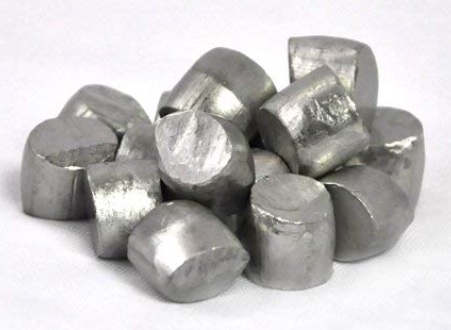
Tin - Plumbum Album/White Lead
And of course graphite (another "pale" substance, which is actually not a metal, but a form of carbon) was mistaken as being a form of black lead and called plumbago, derived from plumbum (lead). It is because of this confusion that modern graphite pencils are called "lead" pencils, when they do not contain lead.
Pewter is similar in its color to both tin and lead. Below are some examples of pewter, lead, and tin paint samples. There are many more tints/shades named after each metal, however, they are all just varying shades of gray.

Paint Color Samples
The name of these metals are sometimes used as adjectives and are synonyms for gray, as with the paint colors, when they are referring to varying shades of gray. These colors are not made out of pewter, lead, or tin but just resemble the look of the metals. So, a person could say, "The wall is pewter," and mean that it is gray, and not mean it is made out of the metal pewter.
In Greek pelios is "livid (dark bluish gray [i.e., leaden] in color), dark," and polios is "gray"(as in of hair, wolves, waves), from PIE *pel- (1). So here again we see this root [*pel-(1)] sometimes related to the appearance of gray things and lead. It is also related to the appearance(color) of animals such as wolves and pigeons. Pigeon in fact, in Greek is peleia, pigeons being shades of gray, not unlike pewter.

Wolf Gray Textile
Pewter can also be related to another meaning of the PIE root (*pel-), namely, *pel- (3) "hide, skin." Wolves often have a pale or gray coat / pelt of varying shades, from white to dark gray, which could be said to be their "skin"(and their appearance). Pelt is a "skin of a fur-bearing animal," from *pel- (3) "hide, skin". Many types of pelts (from*pel-[3]) of animals are pale (from*pel-[1]) in color. The pelts of wolves are pale polios (gray), and even sometimes more pelios (dark or livid).
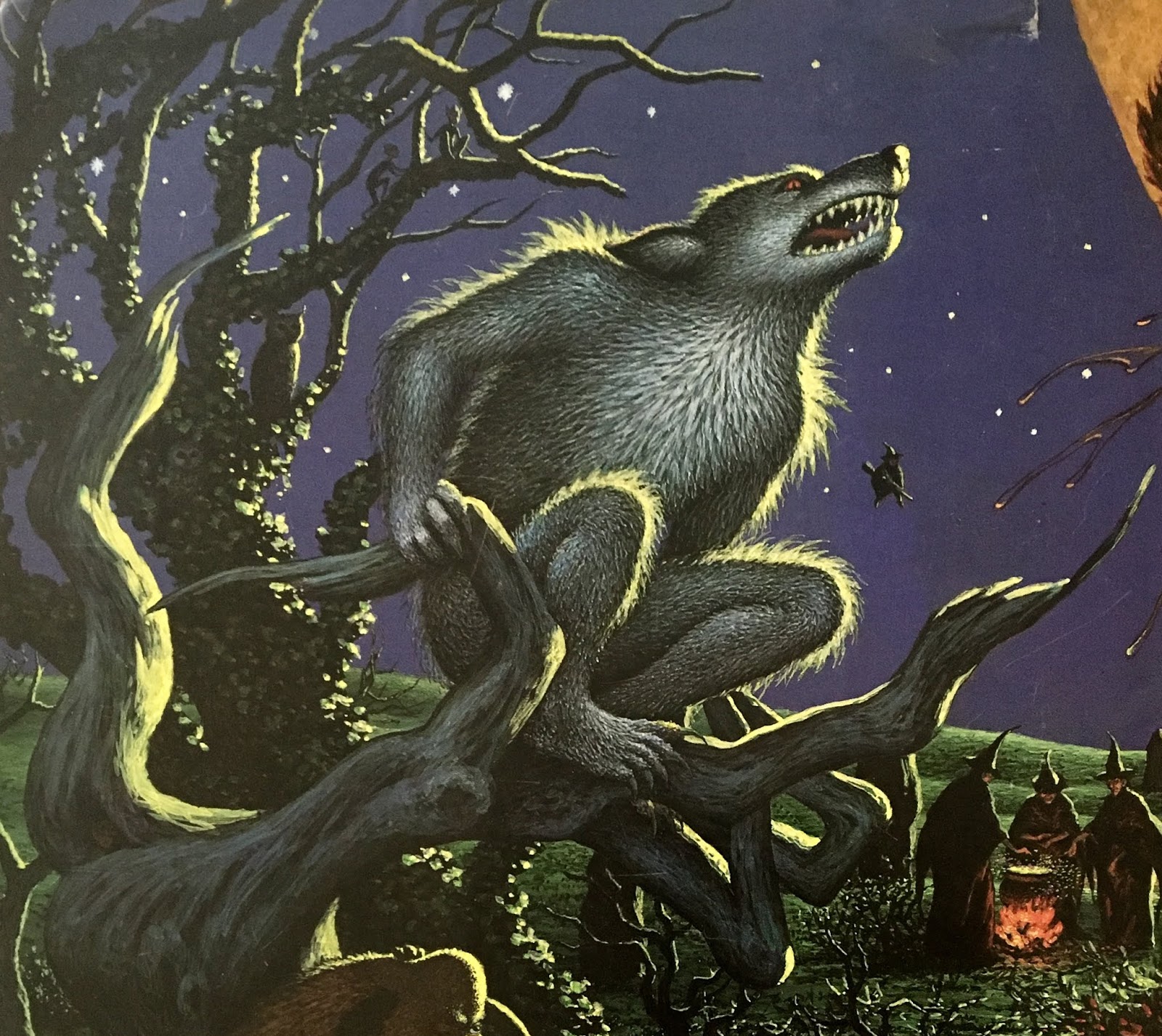
Magical Beasts Pop-Up, Illustration Anne Sharp(2003), photo by Julie O.
In Canto I of Dante's Inferno (begun c. 1308, completed in 1320) there is a description of three beasts guarding the way to the "shining Mount of Joy". The third beast is a She-Wolf,
. . . And down his track, a She-Wolf drove upon me, a starved horror
ravening and wasted beyond all belief. She seemed a rack for avarice
[*tutte brame], gaunt and craving. Oh many the souls she has brought to endless grief! – Canto I, 50, John Ciardi

Dante Running from the Three Beasts,1824-7, William Blake
Next we are told of the hound who will come and hunt down this wolf. The Italian text is,
Questi non ciberà terra né peltro, ma sapïenza, amore e virtute, e sua nazion sará tra feltro e feltro. – Canto I, II. 103-104Peltro in Italian is "pewter". This phrase is somewhat enigmatic, and is translated in various ways putting different interpretations upon the word peltro.
In this English translation below, the Italian peltro is translated literally in order to keep in the style of Dante's rhyme, i.e., terza rema, "third rhyme". In English "pewter" does not rhyme with Fletro, as peltro does with feltro in Italian, so the word order is changed to rhyme "ground" with "abound" instead.
His food shall be not pewter, nor the ground . . . where either Feltro sets abound . . . – Translation in the tera rema of the original, by W.E. Painter, (1843)The hound will not feed on pewter, nor the ground? What does that mean even?
In some English translations license it taken with the rendering of peltro / pewter, as perhaps was the intent of the original. In this translation from Henry Wadsworth Longfellow, peltro/pewter is translated as "pelf", pelf meaning "money, especially when gained in a dishonest or dishonorable way".
He shall not feed on either earth or pelf, But upon wisdom, and love and virtue; 'Twix Feltro and Feltro shall his nation be; – Canto I, (1867)And here, in the John Ciardi translation peltro is "loot",
. . . before the Greyhound comes to hunt her down. He will not feed on lands nor loot, but honorCiardi's translation of the description of the wolf as "a wrack for avarice," avarice meaning "extreme greed for wealth or material gain," in the previous stanza [mentioned above] seems to support this translation of "loot", however, the word choice is, rather, a choice than a true translation of brame "craving, desire, lust, hunger," whereas avarizia "avarice" is not the word used in the Italian text.
and love and wisdom will make straight his way. He will rise between Feltro and Feltro, and in him shall be the resurrection and new day. – Canto I, stanza 95, (1954)
Ed una lupa, che di tutte brame sembiava carca ne la sua magrezza ...Therefore, this description does not necessarily point to greed for wealth specifically, but perhaps just ravenous hunger, or intemperate behavior in general.
Earth, ground and land are all meanings of the Italian terra. This last translation of "lands and loot" seems to steer the meaning of what the hound shuns in favor of more honorable or spiritual fare, toward the sense of acquisitions and power, such as gained by conquering. So, "loot and lands" as fare, seem to points to a vice such as avarice specifically.

Roman Hunter, Dusan Markovic(2018), Deviant Art
It could be assumed that the word "pelf" and "loot" are used in the place of "pewter" because of the fact that money is made from metals, and pewter is a metal. So the assumption would be that Dante used the word peltro loosely to mean pelf/loot just because it rhymes with feltro, and not necessarily because it was the most appropriate word to use.
As far as I know, the word peltro is not commonly meant to mean pelf or loot. And, the word pewter in English itself is not a common way to refer to money/coinage, even if the name of other metals are used in this way.
A common coin used during the Middle Ages was a small silver penny (pfennig) or denarius. Other metals in use for coinage during the Middle Ages were gold and copper.

Silver denarius, dating to the year 77 BC, depicting the goddess Roma and the she-wolf(Crawford 388/1b)
Silver can be used as a word to mean "money", as in silver coin, a person can be paid in silver(coin). However, the question is whether peltro (pewter) was meant to be used in this way to mean "money".
According to the etymology dictionary pelf (n.) is from mid-14c., "stolen goods," from Anglo-French pelf, Old French pelfre "booty, spoils"(11c.), of unknown origin. Its meaning as "money, riches," with pejorative overtone first recorded c. 1500. So it would be a more modern interpretation of the word "pelf" to mean "money" particularly rather than the more general "loot"(which is valuables as well as money). And it may not be the case that the word pelf evolved from some connection with the metal peltro (pewter) just because they both begin with -pel, even if this seems compelling, and a reason to use the word "pelf" specifically.
The origin of pelf is said to be unknown, but is suggested as being possibly related to pilfer. In that case, if true, pelf would originate from the root *pil- rather than *pel-. And this his makes sense when looking at the connection of the meaning of pelf to the definition of other "pil-" words such as pilfer and pillage. Pilfer(v.), for example, from 1540s, is from the Old French pelfre(n.) "spoils, boody" as well. Both "pelf" and "pilfer", being from pelfre, are said to be of unknown origin.
However pillage, from late 14 c., which is similar in meaning to pilfer, is from Old French pilage "to plunder, loot, ill-treat, is possibly from Vulgar Latin *pilliare "to plunder," said to be probably from a figurative use of Latin pilare "to strip of hair." So if pillage is connected to the Latin word pilus (plural pili) "hair," we might connect pillage to the notion of pile "things heaped up", or "a mound," this idea coming from what is commonly done to pili "hair." Pili is piled on top of the head. And also, sadly, pili (the hair), with the scalp attached can be pillaged from a person's head.

Smaug (and his loot). Illustration by Livia Ruzz for the 1975 Romanian edition, The Hobbit
The point of this whole consideration being that word pelf would not be etymologically connected to the Italian word peltro (pewter). And then, therefore, if this word, pelf, was chosen to translate the word peltro, it would have to do with the fact that pewter is a metal of value [it did in fact have high value during the Middle Ages], which might be considered "loot." But this loot, i.e., pewter (if meant to mean loot), would 1.) not necessarily have the connotation of "money" as such, rather just the notion of being of value. And 2.) peltro/pewter would not etymologically be related to the word pelf "loot." Pelf would rather have to do with piles of pilfered goods.
It seems like the sense of pewter, if used to mean pewter "the metal," was not referring to pewter coins, necessarily, but rather as a synonym for articles of value (probably stolen), as in, loot. So the question would be, was the word peltro, as in "the metal" pewter, used in the 14 c./ or meant to be used in this case by Dante, as a synonym for loot? Furthermore, is the translation of "earth and pelf,"or "lands and loot" [being things which are presumably figuratively eaten], a meaningful/fitting juxtaposition to "wisdom, love and virtue (virtute)"? Is loot/spoils/pelf something that is figuratively said to be fed upon? And was the word peltro meant to mean something of great value, or was it actually the opposite, meaning something base or common?
Before answering that question further. I'd like to entertain a different possible hypothesis.
Might the word peltro possibly be calling to mind something pale or gray ("pewter" adj.) and maybe earthy, or not of particular excellence? The gray is mundane, it's not exciting like the colors of a rainbow. It's not that there is anything wrong with earth, or gray, but they aren't particularly thrilling or elevated fare either. So rather than being vicious, they are, rather, just base. Gray is unexciting. And the earth/ground is itself literally base, being the thing we stand on below the heavens. Creatures are made from the earth and that is meant to be humbling.
Then the LORD God formed a man from the dust [aphar] of the ground [adamah] and breathed into his nostrils the breath of life, and the man [ha adam] became a living being. Genesis 2:7, NIV

Light Sculpture, by Paige Bradley
By the sweat of your brow you will eat your food until you return to the ground [ha adamah], since from it you were taken; for dust [aphar] you are and to dust [aphar] you will return. Genesis 3:19

"Migrant agricultural workers", Dorothea Lang, Nipomo, California, March 1936
Remember aphar in Hebrew is "dry earth, dust; ashes, dirt, earth, rubble, plaster, ground, mortar," and the word ophereth "lead" comes from this. Lead, which is another gray metal is a component of ancient pewter.
If you are what you eat, then eating earth points to being made of, or being of, the earth, and having earthly concerns and thoughts, and maybe not caring to endeavor to rise above this base nature, unlike the person who feeds off of wisdom, love and virtue.

Sheaves of Wheat, Pslams of Joy, The Children's Bible, 1965, photo by Julie O.
Even eating what is grown or produced out of the earth, let alone dirt, such as, wheat/bread is still base to a certain extent because it feeds the body. Jesus talks of having food (and therefore eating of it) which is more spiritual in nature.
Meanwhile his disciples urged him, "Rabbi, eat something." But he said to them, "I have food to eat that you know nothing about." John 4:31-32and what was this food that he had?
Then his disciples said to each other, "Could someone have brought him food?" John 4:33, NIVNo,
"My food," said Jesus, "is to do the will of him who sent me and finish his work. . . John 4:34
And again, as Jesus said to the tempter in the desert,
"It is written: 'Man shall not live on bread alone, but on every word that comes from the mouth of God.'" Matthew 4:4, NIV

Temptation of Christ, Vasily Surikov, 1872
This meaning of peltro, as being something gray and of the earth, would seem to fit with the sense of the rendering of "terra né peltro" in a translation by Robert Pensky. He combines terra (earth) and peltro (pewter) into the single concept of "earthly fare." Earthly fare alludes to that which is common or base, as opposed what is virtuous and worthy. And thus it carries a negative connotation, as with the serpent in Genesis who was cursed to eat, or feed off of dust.
So the LORD God said to the serpent,"Because you have done this, "Cursed are you above all livestock and all wild animals! You will crawl on your belly and you will eat dust [aphar] all the days of your life. Genesis 3:14, NIV

The Children's Bible[inside cover detail], 1965, photo by Julie O.
So, is the hound possibly feeding off of wisdom, love and virtue as opposed to this earthly fare? Perhaps not feading off of earth (adamah) or dust (aphar), as an allusion to the creation story?
Intriguingly, it is not even a completely outlandish to say that an animal would eat earth and dust. In fact, some animals do eat dirt, even clay specifically. This practice is called geophagia (earth + eat). Geophagia was first described by Galen, the Greek philosopher / physician in the second century AD. He recorded how certain sick or injured animals ingest clay. It is a practice found in the human animal population as well.
In the south it was and still is a common practice. "I remember my mom and my aunties eating that white dirt like it was nothing," says Hilmam, who grew up in Greene County, Ga., and used to go with her family to dig for their own dirt to snack on. "It was an acceptable thing that people did."
"White dirt" is actually a soft, chalky clay called kaolin and is widely used to make porcelain, paper and paint. The mineral kaolinite is one of the most common in the world, and best-known deposits are located in the southeastern U.S. NPR, The Old and Mysterious Practice of Eating DirtClay is a type of earth that is sometimes gray (or white, brown, orange-red). Clay is pale. Clay is gray earth. at times it named after its dusty or pale color as some metals are.

Gray / Pewter(colored) Clay
Argil is clay, and especially a white clay used by potters.
Argilla is "clay, argil" in Italian, which comes from the same root as argento "silver", and argent, i.e. *arg-. So in this case clay (argil) and a metal (argent/silver) are named from the same word. Clay can have a silvery color as well as, or like, the metal silver.

White Kaolin Clay Powder
Clay can also be named or described by its pale appearance, as some metals are.
It is interesting that a word for clay in Greek is pélos "clay, mud, slime, pug" in Greek. Does this have to do with the fact that it is sometimes pelios (livid; dark) or polios (gray)? This word is used in this passage from the Gospels when Jesus makes clay to use in a healing of a blind man.
When he had said this, He spat on the ground, and made clay [pelon πηλòν, from pélos "clay, mud ('wet clay')] of the spittle, and applied the clay to his eyes. John 9:6 NASB

Jesus Heals a Blind Man
So the man was humble to have this mud spread on his eyes, and had to act in faith to go and wash in the Pool of Siloam instead of telling Jesus, "no thanks," and not submitting to this weird procedure that had no assurance of working. How many people are "blind" but will not be humble and submit to wisdom, love, and virtue in order to be healed of their blindness? . . . Not accepting that they are dust. . . YET that they are worthy of being raised above their earthy nature?
If clay (argil), especially white clay, is named from the same base as silver (argent), *arg-(to shine, white), then it doesn't seem impossible that other names for clay might come from clay's pale appearance, such as pélos (clay) with the PIE root *pel (1) "pale," embedded in the word itself.
Therefore might peltros used poetically in Canto I possibly be referring to a kind of earth that is pale or peltros(adj.), or, clay? In this way peltros would be juxtaposed to terro, as things of the earth, or types of earth.
Therefore might peltros used poetically in Canto I possibly be referring to a kind of earth that is pale or peltros(adj.), or, clay? In this way peltros would be juxtaposed to terro, as things of the earth, or types of earth.
He shall not feed on either earth or clay, But upon wisdom, and love and virtue. . .But, why not use argilla "clay" in the stanza if it was meant to mean clay? This would be for the same reason the word for silver (argento) would not have been used if pewter (peltro) was referring to money/pelf/loot. Neither argilla (clay) nor argento (silver) rhyme with feltro. But in the same way that peltro might be used poetically to refer to loot, might not peltro also bring to mind the idea of clay? Clay being both white and/or pale? So was the word peltro (pewter) used to mean something like clay or dust due to the fact that peltro rhymes with feltro at the end of the stanza?
Questi non ciberà terra né peltro, ma sapïenza, amore e virtute, e sua nazion sará tra feltro e feltro. —Canto I, II. 103-104
It is fascinating that under this hypothesis, i.e., peltrum referring to clay or dust, that a Hebrew word for "clay" is tin (phonetic teen), also meaning "common." NAS Concordance says this is from (Aramaic) perhaps corresponding to tit "mud, mire, clay." So here a word which in English means the metal tin, in Hebrew, a similar sounding word means "clay." And clay can be tin, lead, or pewter colored. So literally clay(n.) is tin(adj.), and tin is "clay". Furthermore, pewter is similar in color to plumbum (lead and tin), so pewter(n.) is tin(adj.), and tin(n.) is pewter(adj.) as well. Therefore in this sense we can say clay is pewter.
Tin, also, somehow inherited in its name the idea of something less pure than it actually is. Tin is an element designated Sn, from Latin stannum, and is not an alloy of various metals. However, before the sixth century stannum referred to a mixture of silver and lead rather than tin.
. . . the ancients obtained, as we do, a great deal of lead from argentiferous ores, from which they separated the silver and revived the lead. The ore was pounded very fine, or, as we say, stamped; it was then washed and roasted, and formed into a powder or paste. This was then put in a furnace, and by the first fusion gave a regulous consisting of silver and lead, which was called stannum, and was the same substance as that known to our metallurgists by the name of werk. The History of Inventions and Discoveries, Volume 4, by Johann Beckmann, p. 9Eventually, however, this word, stannum, came to refer to tin, and in modern usage replaced the name plumbum candidum (white lead). The etymology dictionary says that stannum is a scribal alteration of Latin stagnum, which is also the source of the Italian stagno, French étain, Spanish estaño. So we can see from the French and Spanish rendering how the English word "tin" is related to stannum in sound even though it is not immediately obvious. And also how this Latin word stannum/stagnum (and Italian stagno) is similar to Latin stagnantem (nominative stagnans) "to stagnate," which is not an especially flattering connection.
Tin is something that needs to be extracted, generally, from ore. A chief source of tin is cassiterite. Tin is extracted by a process that involves smelting (which is extracting [metal] from its ore by a process involving heating and melting).

Smelting ore
Tin is a very soft metal, but is an important element when used in combination with other metals, such as copper in the making of Phosphor Bronze (an alloy), which is actually stronger and less corrosive than copper alone. An alloy is "a metal made by combining two or more metallic elements, especially to give greater strength or resistance to corrosion." So, perhaps it is because of this process that tin is related to stannum.
In Hebrew the name for tin also carries some negative connotation. Tin is bedil " alloy, tin, dross" in Hebrew, from badal "to be divided, separate," (therefore not unlike the process of smelting). So it is more of a generic name, but actually, the bedil of the bible, referred to an alloy.
The Tin of the bible ([kassiteros] in the Greek version) corresponds to the Hebrew [bedil], which is really a Copper alloy known as early as 1600 BC in Egypt. Stannum Tin, Elementemology & Elements Multidict, elements, vanderkrogt.organd in Isaiah this bedil is figurative of evil of Jerusalem [Brow-Driver-Briggs concordance]
I will turn my hand against you; I will thoroughly purge away your dross and remove your impurities [bedil]. Isaiah 1:25 NIVAlso,
When I turn my attention to you, I'll refine your dross as in a furnace. I'll remove all your alloy [bedilayik, from bedil]. Isahah 1:25 ISV, HebrewSo this word bedil, originally referring to an alloy of copper in Hebrew, eventually became the word used for "tin." And, tin, although not an alloy itself, is often used in the making different alloys. Pewter, on the other hand, is an alloy (of tin). And In Greek there is just one word referring to both tin and pewter.
Kassíteros in Greek is "tin," but also the adjective "pewter", the name having to do with a region where tin is mined, rather than a name deriving from its appearance. Pewter(n.) is kráma kassíterou, from kráma (alloy) + kassíteros (tin) is pewter(n.). So pewter is "alloy of tin" in Greek. Given these things, there is some argument for saying pewter, as an alloy of tin, carries with it some of the same etymological baggage as tin does, such as "dross." Not to say that tin or pewter are in fact "worthless," but they aren't considered the most noble of the metals (such as gold, silver and platinum).
So, where does this leave us in our consideration of the rendering of peltro into English in Canto I of Dante's Inferno?
If left simply as "pewter," it is curious to the reader. Eating earth is one thing, but eating metal is another. It's not really possible for a hound to eat metal [However, there was some debate during the Middle Ages as to whether or not ostriches ate and/or digested iron. Midieval Animal Data-Network, Fact Checking:Can Ostriches Digest Iron?]

Shattered Teeth, Tom & Jerry
It is obviously meant to be taken figuratively.
Given this, there are two meanings of pewter: 1.) pewter is a noun meaning a certain type of metal, and 2.) it is an adjective which refers to a gray color. And "pewter," as an adjective could perhaps then be meant to refer back to a noun (possibly dirt/clay) of the same color.
Pewter if taken as a metal, and figuratively interpreted as "loot" or "pelf," has the meaning of riches (perhaps stolen goods). However, if peltro instead means something pale, like clay, the sense of the phrase terra né peltro translated as "earthen fare," figuratively means what is base, rather than meaning specifically lust or greed, and the word peltro is not directly translated.
Whatever Dante intended to mean by this word, peltro, we know that it, along with terra, is contrasted to wisdom, love, and virtue (which are themselves only figuratively eaten as well). An interpretation, such as proposed in this post, that peltro might allude to dust or clay (which may not be as much of a stretch in Italian as it is in English) offers a general and fitting contrast to the more noble fare of wisdom, love and virtue, and also nicely alludes to classic biblical themes, such as the snake in the garden, who bit the dust.
The hound, however, was not another one who bites the dust . . . perhaps . . .
But the answer doesn't seem to be black and white, rather, more shady, maybe even an everyday gray.


Given this, there are two meanings of pewter: 1.) pewter is a noun meaning a certain type of metal, and 2.) it is an adjective which refers to a gray color. And "pewter," as an adjective could perhaps then be meant to refer back to a noun (possibly dirt/clay) of the same color.
Pewter if taken as a metal, and figuratively interpreted as "loot" or "pelf," has the meaning of riches (perhaps stolen goods). However, if peltro instead means something pale, like clay, the sense of the phrase terra né peltro translated as "earthen fare," figuratively means what is base, rather than meaning specifically lust or greed, and the word peltro is not directly translated.
Whatever Dante intended to mean by this word, peltro, we know that it, along with terra, is contrasted to wisdom, love, and virtue (which are themselves only figuratively eaten as well). An interpretation, such as proposed in this post, that peltro might allude to dust or clay (which may not be as much of a stretch in Italian as it is in English) offers a general and fitting contrast to the more noble fare of wisdom, love and virtue, and also nicely alludes to classic biblical themes, such as the snake in the garden, who bit the dust.
The hound, however, was not another one who bites the dust . . . perhaps . . .
But the answer doesn't seem to be black and white, rather, more shady, maybe even an everyday gray.

Albero di terra e peltro, Black and White Edit, art by Ailis O'Reilly

Albero dell'amore a colori, Original art by Ailis O'Reilly